Category Archives: Uncategorized

JOINT DISTRICT CONVENTION OF AIBDPA & BSNLEU, MANGALORE.

Image may contain: one or more people

Image may contain: 11 people, including Nallusamy Veeramalai, people smiling, people sitting, crowd and indoor

Mangalore District Branches of AIBDPA & BSNLEU jointly organised a convention on 29-09-2018 which was inaugurated by Com.V.A.N.Namboodiri, Advisor. In his inaugural address, Com.V.A.N.Namboodiri vividly explained the current developments; the anti-people policies of Modi government, decision of Central Trade Unions for a two day Strike on 8th&9th january, 2019, present position of wage revision and pension revision and medical issues.

Coms.V.C.Naik and Gopal Poojary, District Presidents of AIBDPA and BSNLEU presided over the convention. Com.B.P.Narayana, District Secretary, AIBDPA welcomed one and all. Veteran Leader Com. Harish Chandra Rao, Com.Tanveer Pasha, District Secretary, BSNLEU, Coms.Gururaj and Deekayya, Circle leaders of BSNLEU and Com. Thimmappa.v, District Treasurer, AIBDPA addressed. 

WEST BENGAL EXTENDED CIRCLE EXECUTIVE COMMITTEE MEETING.

Image may contain: Biplab Das, sittingImage may contain: one or more people

Com.Omprakash Singh, General Secretary, BSNL Co -Ordination Committee inaugurated the West Bengal Extended Circle Executive Committee meeting at CTO hall, Kolkata on 06-10-2018. Com.Susanta Ghosh, Circle President presided over the meeting. Other speakers were Coms.D.Basu, AGS, Banani Chattopadhyay (Working Women ) and Debasis Khan (BSNLEU). Com.Pijush Chakraborty, Circle Secretary and P.K.Nandi, Treasurer presented the report and accounts, respectively. 14 district secretaries and 15 branch secretaries participated in addition to the circle office bearers. After an active discussion and reply by Circle Secretary both the report and accounts were adopted.

The meeting decided to put in maximum efforts to make the 3rd triennial AIC at Kolkata a grand success. The CEC decided to prepone the Protest Day called by CHQ to 12-10-2018 in the wake of Durgapooja.   


INDIA PENSION SCANDAL – Article by Prabhat Patnaik

Incredible as it may seem, the union government of India provides a pension to the elderly which amounts to an absurd sum of Rs 200 each per month, and even for accessing this the beneficiary must belong to the BPL population which, as is well-known, is notoriously underestimated. True, the state governments add something to this amount, but, their resources being meagre, the additions cannot be large. What is more, this figure of Rs 200 has remained unchanged since 2006-07; even the elementary courtesy of indexing it to inflation has not been accorded to the elderly.

This is truly a scandalous state of affairs, not just because the sum is laughably paltry, the beneficiary list absurdly truncated, and even elementary protection against inflation missing, but above all because of what it reveals about the government’s attitude. This attitude sees the payment of pension as a largesse on the part of the State, an act of charity towards a set of mendicants. But an adequate old-age pension is actually a right. It is a right not just in an abstract “ought”-sense, but in the concrete sense of being an integral part of the social philosophy which underlay India’s anti-colonial struggle and upon which the Indian constitution is founded.

This philosophy which the Left has always espoused holds that the plight of an individual in society is determined by the social arrangement within which he or she lives. For instance unlike the colonialists of the pre-independence era who attributed the misery of the Indian people to their “laziness”, or lack of enterprise, or subservience to tradition, the anti-colonial struggle advanced the proposition that it was the colonial arrangement that caused the abject poverty afflicting India, whence it followed that this arrangement had to be altered by overthrowing colonial rule and erecting an alternative social arrangement that would guarantee a minimum standard of life to every Indian. The Karachi Congress Resolution in 1931, which outlined what free India would look like, held out this promise, among others. The mass participation in the freedom struggle that occurred in the 1930s was fired by this promise, which thus became a sort of “freedom charter”, upon which the new nation was founded. It acted as a precursor to the constitution.

Even though the constitution did not explicitly codify a set of fundamental economic rights, as it codified a set of fundamental political rights, the former cannot just be wished away, both because they form part of the “freedom charter” underlying the new nation, and also because the latter cannot be enjoyed without the citizen also enjoying a set of de facto economic rights. The assertion of one’s role as a citizen in a democracy cannot occur unless one enjoys a degree of economic security. Hence even though economic rights are not codified as such in the constitution, they are implicit and as fundamental as the explicitly-codified fundamental rights.

Adequate pension to the elderly is one such economic right. It is inherent in the promise underlying the constitution of free India which is visualised as a fraternity of equal citizens. Within this fraternity of equal citizens, nobody is doing anyone else a favour by accepting a legitimate demand for a minimum livelihood.

If adequate pension is an economic right, then it must be universal, like the fundamental political rights enjoyed by all. The pension scheme cannot be either contributory or means-related. It cannot be targeted, not just because any targeting invariably leaves out many deserving beneficiaries, but, more importantly, because it violates the principle of universality that must characterise all rights of citizens. To be sure, in fixing the amount of pension, the fact that a person is already drawing a pension from some other source must be taken into account; and once deduction is made on that score some will automatically get excluded or drop out, but that does not amount to an infringement on a person’s right. Likewise the pension paid by the State to every elderly person as a right must have nothing to do with any contribution from the person concerned. If someone is part of some other contributory pension scheme, he or she may opt out of the State-funded pension, or the pension amount may be suitably adjusted to prevent double benefits; but State-funded pension must be a right for every person, and it must be financed by budgetary sources, unrelated to any contribution from the beneficiary.

The provision of a laughable pittance as pension, as is the current state of affairs, is therefore a violation of the spirit of the Indian constitution, a throwback to feudal times when rulers occasionally showed kindness to the ruled by bestowing favours upon them, of the sort that our governments think they are doing in providing a pittance for a pension.

The Pension Parishad, a network of several groups, organised a dharna in Delhi on September 30 and October 1 to demand an adequate universal rights-based pension. The principle enunciated by the Pension Parishad is that the amount should be half the minimum wage, but in concrete terms the demand was for a pension of Rs 3000 per person per month. The Pension Parishad has organised a similar dharna in 2012 when the demand had been for a universal pension of Rs 2000 per month. Taking into account the price-rise in the interim, the current demand of Rs 3000 is roughly equivalent to the demand of Rs 2000 at that time.

The appropriateness of this figure can be seen from a different angle. Since poverty in India is defined in terms of a daily calorie-intake norm, namely 2100 calories per person per day in urban India and 2200 calories in rural India, the monthly per capita expenditure at which the calorie intake just met these norms could be taken as the pension amount. NSS data from quinquennial consumer expenditure surveys were used to determine these cut-off levels, and, expressed at prevailing prices, they came, in round numbers, as a weighted average between urban and rural areas, to Rs 2000 per month in 2012, which would work-out to around Rs 3000 today.

The number of potential beneficiaries was estimated by the Parishad in 2012 to be around 8 crores, which by now might have increased to about 10 crores. The annual amount required for providing old-age pensions at Rs 3000 per month to these beneficiaries would therefore come to Rs 3.6 lakh crores; allowing for a 5 percent deduction on account of voluntary drop-outs, what is required is just about 2 percent of the country’s current GDP for financing a universal rights-based pension plan.

The question often raised against such a plan is that the country cannot afford this amount. But 2 percent of GDP, it should be noted, is less than a third of the annual increment that occurs in GDP at present. The provision of this amount of pension, if it is financed through taxes paid out of incomes, would not imply any decline in the average post-tax income of the non-pensioners compared to the preceding year. On the contrary it would still mean that compared to the preceding year their per capita post-tax income would increase by about 3 percent. The payment of pensions on this scale therefore does not require any absolute sacrifice by the non-pensioners compared to the preceding year, only a smaller increase in income than would have occurred otherwise. Nobody in short needs to be squeezed in absolute terms for paying out pensions that provide a minimum living standard to the elderly.

We have assumed above that pensions would be paid out of taxes on incomes; but this is unnecessary. A Tobin Tax on currency transactions, or an increase in the existing tax-rate on stock market transactions, or a straightforward wealth tax would be a far more appropriate way of raising resources for pensions, since it would simultaneously serve other purposes such as curbing speculation or reducing wealth inequality. In fact if we assume, somewhat conservatively, that private wealth amounts to four times the GDP, and that the top 1 percent of households in India owns 62 percent of the total private wealth, then a mere 0.8 percent tax on the wealth of just the top 1 percent of households would be quite enough to finance a universal rights-based old-age pension scheme providing minimum benefits. India’s pension scandal can thus be ended quite easily; why it persists is not any shortage of resources but sheer class-antagonism, since the overwhelming bulk of potential beneficiaries are, or would have been, workers, artisans, craftsmen, peasants, and agricultural labourers.

Fixation of Pay on Promotion from the Date of next increment can be done: DOPT Order

No.13/02/2017-Estt.(Pay-I)
Government of India
Ministry of Personnel, Public Grievances and Pensions
Department of Personnel & Training

North Block, New Delhi Dated 27th July, 2017

OFFICE MEMORANDUM

Subject: Availability of option for fixation of pay on promotion from the Date of Next Increment (DNI) in the lower post and method of fixation of pay from DNI, if opted for, in context of CCS (RP) Rules, 2016-regarding.

Prior to implementation of 6th CPC Report, the pay fixation on promotion was governed by provisions of FR 22(I)(a)(1). In 6th CPC context, the first part of FR 22(I)(a)(1) was replaced by Rule 13 of CCS (RP) Rules, 2008. Similarly, consequent upon implementation of CCS (RP) Rules, 2016 in 7th CPC context, the pay fixation on promotion is regulated by the provisions of Rule 13 of CCS (RP) Rules, 2016. This rule regulates pay fixation on promotion if the same is opted by the employee from the date of promotion itself. The issue of relevancy of provisions of FR 22(I)(a)(1) as well as the methodology of fixation of pay on promotion to a post carrying duties and responsibilities of greater importance, of a Government Servant in case he opts for pay fixation from the Date of Next Increment (DNI) has been considered in this Department.

2. In this context, proviso under FR 22(I)(a)(1) inter-alia provides that the Government Servant (other than those appointed on deputation basis to ex-cadre post or on ad-hoc basis or on direct recruitment basis) shall have the option, to be exercised within one month from the date of promotion, to have the pay fixed under this rule from the date of such promotion or to have the pay fixed from the date of accrual of next increment in the scale of the pay in lower grade.

3. After due consideration in this matter, the President is pleased to decide as follows:

(i) FR 22(I)(a)(1) holds good with regard to availability of option clause for pay fixation, to a Government Servant holding a post, other than a tenure post, in a substantive or temporary or officiating capacity, who is promoted or appointed in a substantive, temporary or officiating capacity, as the case may be, subject to the fulfilment of the eligibility conditions as prescribed in the relevant Recruitment Rules,to another post carrying duties or responsibilities of greater importance than those attaching to the post held by him/her. Such Government Servant may opt to have his/her pay fixed from the Date of his/her Next Increment (either 1st July or 1st January, as the case may be) accruing in the Level of the post from which he/she is promoted, except in cases of appointment on deputation basis to an ex-cadre post or on direct recruitment basis or appointment/promotion on ad-hoc basis.

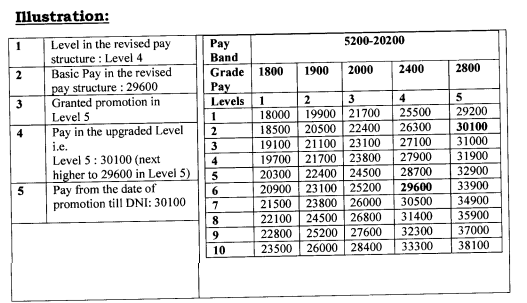
(ii) In case, consequent upon his/her promotion, the Government Servant opts to his/her pay fixed from the date of his/her next increment (either 1st July or 1st January, as the case may be) in the Level of the post from which Government Servant is promoted, then, from the date of promotion till his/her DNI, the Government Servant shall be placed at the next higher cell in the level of the post to which he/she is promoted.

Promotion Pay Fixation and date of Next Increment

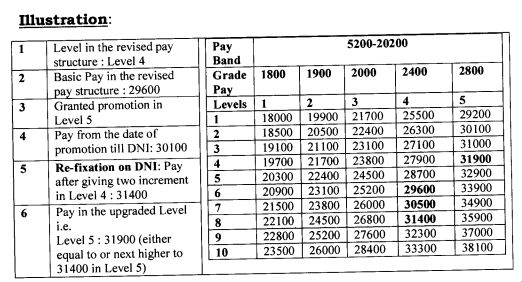
(iii) Subsequently, on DNI in the level of the post to which Government Servant is promoted, his//her Pay will be re-fixed and two increments (one accrued on account of annual increment and the second accrued on account of promotion) may be granted in the Level from which the Government Servant is promoted and he/she shall be placed, at a Cell equal to the figure so arrived, in the Level of the post to which he/she is promoted; and if no such Cell is available in the Level to which he/she is promoted, he/she shall be placed at the next higher Cell in that Level.

Promotion Pay Fixation and date of Next Increment

(iv) In such cases where Government Servant opts to have his/her pay fixed from the date of his/her next increment in the Level of the post from which he/she is promoted, the next increment as well as Date of Next Increment (DNI) will be regulated accordingly.

4. It is further reiterated that in order to enable the officials to exercise the option within the time limit prescribed, the option clause for pay fixation on promotion with effect from date of promotion/DNI shall invariably be incorporated in the promotion/appointment order so that there are no cases of delay in exercising the options due to administrative lapse.

5. In so far as their application to the employees belonging to the Indian Audit and Accounts Department is concerned, these orders issue in consultation with the Comptroller &Auditor General of India.

sd/-
(Pushpender Kumar)
Under Secretary to the Government of India

HUBLI DISTRICT CONFERENCE HELD IN A JUBILANT MOOD.

Image may contain: 3 people, including Retnamma Karunakaran, people sitting, people standing and indoor

Image may contain: one or more people

Hubli District Branch has held its 5th biennial District Conference very successfully on 05-10-2018 at GM Office.(Sanchar Bhawan). Com.S.M.Geeta, District President controlled the proceedings. Com.Muddaiah, Circle Secretary inaugurated the conference with an elaborate speech. A host of leaders including Coms. Harish Doddamani, District Secretary, BSNLEU, N.D.Patil, ADS, BSNLEU,  L.D.Durgad, Circle Vice President, BSNLEU, H.B.Naik, District Secretary, Ranebennur addressed the conference.

Delivering the keynote address, Com.G.G.Patil, AGS gave a good account of the issues confronting the pensioners with special focus on pension revision, wage revision and medical issues. He also exhorted to make the protest day called by CHQ against nonpayment of medical allowance and unbearable delay in settlement of medical bills on 16-10-2018 a grand success. 

Com.A.D.Kulkarni, District Secretary welcomed one and all and presented the biennial report and audited accounts which were adopted after discussion.

Thereafter office bearers were elected unanimously with Com. S.M.Geeta (President), Com. A.D.Kulkarni (District Secretary) and Com.R.Y.Shalgar (Treasurer)

PFRDA issued Public Notice to Alert NPS Subscribers


PUBLIC NOTICE

“This is to inform general public that PFRDA is a Regulatory Body and does not ever call for any sum for release of funds to any individual from their Permanent Retirement Account (PRAN) maintained with the Centre Record Keeping Agency.

It is also informed that PFRDA has appointed entities such as Point of Presence, Aggregators etc. which are banks and non-banking financial companies which are authorized to interact with subscribers for a prescribed fee which is much less than what is being asked for by the fraudsters.

PLEASE BEWARE. PFRDA NEVER SENDS ANY EMAIL/MESSAGE PROMISING LARGE SUMS FOR PAYMENT OF FEE/CHARGE. ANY SUCH COMMUNICATION IS SENT WITH THE INTENTION TO DEFRAUD YOU. INFORM POLICE IMMEDIATELY.”

Inconvenience to CGHS Beneficiaries should be avoided – Private HCOs are advised

CGHS reiterated the Private HCOs to avoid the practices which is causing inconvenience to CGHS Beneficiaries .

Govt of India
Office of the Additional Director
CGHS (HQ)
Sector-12, R.K.Puram, New Delhi-22

Dated: 24 -09-2018

OFFICE MEMORANDUM

Sub: Directions to Private HCOs empanelled under CGHS regarding simplification of procedure for treatment at private hospitals empanelled under CGHS/CS (MA) Rule, 1944.

With reference to the above mentioned’ subject the undersigned is directed to state that this Ministry has been receiving various complaints regarding difficulties being faced by CGHS beneficiaries in getting the OPD/IPD treatment at Pvt. HCOs after valid referral from the CMO/MO/Govt. Specialist. It has been viewed very seriously by the Competent Authority.

It is observed that the CGHS beneficiaries are facing a lot of resistance from the staff/OPD manager/Doctors of the private NCOs empanelled under CGHS_ CPD timing are clubbed with General OPD or OPD for EWS, which is causing inconvenience to the CGHS beneficiaries. OPD Slot for CGHS beneficiaries is also reduced to half an hour, The CGHS beneficiaries are not allowed to seek the consultation from the Senior Doctor or their OPD, so called premium OPD.

It is reiterated that HCOs empanelled under CGHS shall adhere to the term and conditions while providing treatment/investigation facilities to the CGHS beneficiaries. The private HCOs empanelled under CGHS shall provide quality service to CGHS beneficiaries and care may be taken to avoid inconvenience, especially for the Senior Citizen, Cancer Patients and terminally ill patients. Pvt. HCOs shall avoid any discrimination to CGHS beneficiaries.

As per MOA clause No. 18 (9) discrimination against CGHS beneficiaries’ vis-å-vis general patients — “The amount of Performance Bank Guarantee will be forfeited and the CGHS shall have the right to de-recognize the Health Care Organization as the case may be. Such action could be initiated on the basis of a complaint, medical audit or inspections carried Out by the CGHS teams at random. The decision Of the CGHS will be final.

All the empanelled HCOs under CGHS Delhi/NCR are hereby warned/directed to follow the specified guidelines laid down in MOA and OMs issued by the Ministry Of Health & Family Welfare, Govt. of India from time to time, failing which the Show Cause Notice will be served and action as deemed fit shall be taken.

This issues with the approval of Competent Authority.

sd/-
Dr. Sanjay Jain
Addl. Director, CGHS (HQ)

INSPIRING KOZHIKODE DISTRICT CONFERENCE

Image may contain: 5 people, including Shine Ac and Biplab Das, people sitting

Image may contain: 6 people, people standing

Com.M.Kunhikrishnan, All India Vice President, LICEU inaugurated the 5th biennial Kozhikode District Conference in an enthusiastic atmosphere at Kozhikode on 03-10-2018. He thoroughly exposed the anti-people and anti-worker neo liberal policies of Narendra Modi government and the threat being posed by the sangh parivar organisations against the secular fabric of the country.  Delivering the keynote address, Com.V.A.N.Namboodiri explained the recent developments on wage revision, pension revision, medical facilities and the struggles being conducted for the settlement. Initiating the discussion on organisation and issues, Com.N.Guruprasad, Circle Secretary dealt in detail as to how AIBDPA is growing through struggles all over the country. Com.R.Vijayakumar and K.Sreenivasan (BSNLEU), V.Nambiar(AIPRPA), P.Kunhiraman (CGPA), K.V.Sasidharan (SNEA) and T.T.Asokan (CCLU) greeted the conference.

Com.M.P.Velayudhan, District President was in chair. Com.P.V.Chandrasekharan, District Secretary welcomed all and presented the biennial report and Com.M.K.Prabhakaran, Treasurer submitted the audited accounts which were adopted after discussion.

It was reported in the conference that an amount Rs.10,54,000 has already been sent to the Chief Minister’s Distress Relief Fund so far from the district through online transfer individually and district branch which was appreciated by all.

Office bearers were elected unanimously with Com.M.Chandran (President), Com.P.V.Chandrasekharan (District Secretary) Com.M.K.Prabhakaran (Treasurer).