
Category Archives: Uncategorized
COM.M.P.KUNHANANDAN, FORMER CHQ TREASURER REMEMBERED.


The 3rd death anniversary of Com.M P Kunhanandan, former CHQ Treasurer was observed befiitingly by Kozhikode District Branch on 14-06-2019. Com.V A N Namboodiri, Advisor presided over the meeting held at Telephone Exchange Club hall, Manamchira, Kozhikode. Com.P V Chandrasekharan District Secretary welcomed. Prof.T P Kunhikannan spoke on Public Sector, Democracy and Future of India. Com.M .Vijayakumar, AGS, BSNLEU delivered the commemorative speech
NAGERCOIL DISTRICT CONFERENCE HELD SUCCESSFULLY.
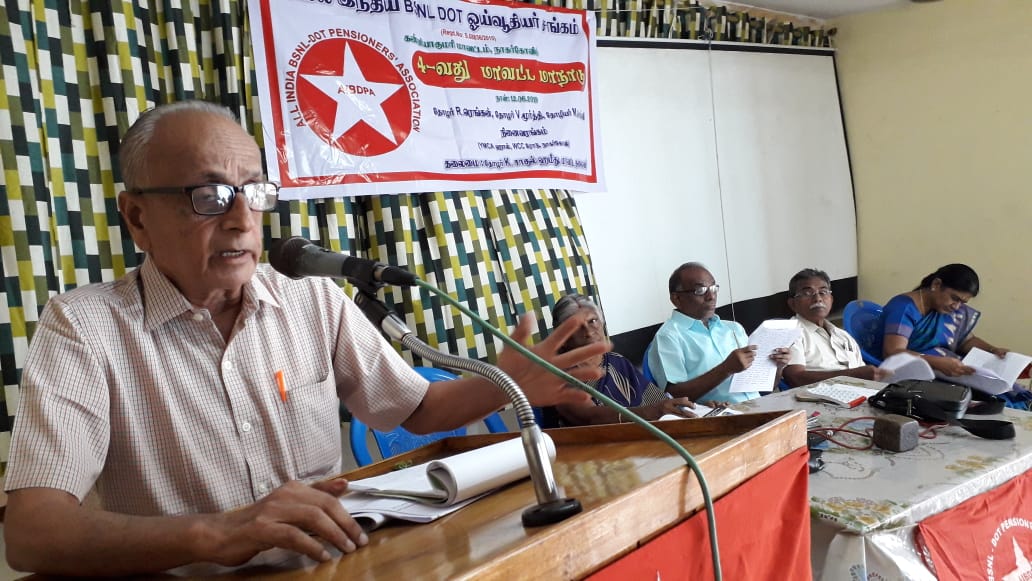

The 4th Nagercoil District Conference has been held befittingly at YMCA Hall, Nagercoil on 12-06-2019. Senior leader and District Vice President Com.K.Kaliprasad presided over the conference. Com.A.Meenakshisundaram, District Secretary welcomed the gathering. Inaugurating the conference, Com.C K Narasimhan, Circle Secretary called upon to make the 5th Circle Conference being held at Coimbatore on 29th & 30th June, a grand success. Com.P. Manickamurthy, Circle President delivered the special address. Coms.V P Indira, Convener, BSNLEU Womens Committee, Raju, District Secretary, BSNLEU, Rajanayakam, District Secretary, NCCPA also addressed.
The biennial report and audited accounts presented by the District Secretary and Treasurer were adopted after discussion.
Thereafter a new set of office bearers with Com.K. Kaliprasad (President), Com. A. Meenakshidundaram (District Secretary) and Com.Hariharan (Treasurer) were elected unanimously.
HOW PSUs ARE MADE UNVIABLE- AIR INDIA EXPERIENCE- AN ARTICLE IN FINACIAL EXPRESS
Grounding the Maharaja: How UPA clipped Air India’s wings
Published: June 13, 2019 12:22:57 AM
Acquisition of more aircraft than required, a badly planned merger, and massive increase in bilateral air traffic rights to Gulf nations took Air India to the ICU.
 According to a 2011 India Today report, it is clear that Air India’s financial problems began in 2004
By Sanjeev Nayyar
It took five years of the Modi government for the Enforcement Directorate to summon former civil aviation minister Praful Patel for questioning “over an alleged aviation scam”.
While law will take its own course, this article jogs your memory with what happened then—Air India/Indian Airlines merger, acquisition of aircraft and bilateral traffic rights.
One, have you heard of a company that makes a financial commitment of about `67,000 crore for purchase of 111 (AI 68, IA 43) aircraft on an equity base of `586 crore (AI `153.84 crores, IA `432.13 crore) and carry-forward losses of `776 crore (Indian Airlines brought forward loss of `957 crore less Air India profit reserves `181 crore) as on March 31, 2006?
According to a 2011 India Today report, it is clear that Air India’s financial problems began in 2004, when Praful Patel chaired a meeting of the board, in which, the airline suddenly inflated its order for new aircraft from 28 to 68 without a revenue plan, or even a route-map for their deployment.
This is substantiated by the former executive director of Air India and author of The Descent of Air India, Jitender Bhargava: “The Air India Board-approved purchase of 28 aircraft in November 2003 includes 10 medium-capacity long haul aircraft. During UPA, the number of long-haul aircraft was increased from 10 to 50,” and, “despite the recommendations of the techno-economic committee and the AI board that two-third of the 50 aircraft should be ordered on a ‘firm basis’ and the rest on ‘option,’ the empowered group of ministers decided to order the entire lot on a firm basis.”
Two, one does not need to be a qualified accountant to know that making huge financial commitments on a low equity base is a precursor to bankruptcy or a government bailout.
It can be argued, fairly, that aircraft orders were placed because IA had not purchased any new aircraft since 1990. However, financial commitments must be based on the ability to repay debt.
Three, the UPA presented the merger of Air India with Indian Airlines as a solution to their problems. Before the merger proposal, UPA changed the name of Indian Airlines to ‘Indian’ accompanied by a smartly designed logo.
Even before all the IA aircraft sported the new logo, the Ministry of Civil Aviation, in a letter dated April 20, 2006, asked the Air India board to work towards a merger with Indian Airlines.
Further, Bhargava wrote, “It took more than two years for the ministry to initiate action on a merger, and then the matter moved with uncharacteristic haste. What makes the timing suspect is that it was done barely months after both airlines had placed their orders for large number of aircraft IA 43 and AI 68. If merger was on the cards the orders could have been placed together and NACIL could have gotten a far better deal.”
The merger of AI with IA was to give scale and integrate operations, but many issues, including human resources, were left unresolved.
With this, the ‘Indian Airlines’ brand, as much a part of our lives as Colgate, was now dead.
Four, in a July 18, 2009, Business Standard article, Surajeet Dasgupta says, “Within the overall west Asian pie, Emirates has seen its capacity rise four-fold, from 12,400 seats per week in 2004 to 48,600 in 2008; Etihad Airways from 1,600 to 8,500, even tiny Air Arabia’s capacity is more than that of British Airways and is quickly closing in on Lufthansa.”
Further, a January 21, 2013, Business Standard report states, “The Comptroller and Auditor General (CAG) on Thursday criticised the civil aviation ministry for granting “massive increases” in bilateral air traffic rights to Gulf nations in 2004-05, despite Air India’s (AI) “strong reservations,” as this was its most profitable international sector. Between May 2007 and March 2010, the Dubai sector saw the number of seats per week rise from 18,400 to 54,200.”
Five,the same report also tells how 6th Freedom rights, under which foreign carriers can fly passengers from one country to another while stopping in their own country, choked AI:“Airlines like Emirates, Lufthansa, British Airways, Qatar, Gulf Air and Singapore Airlines—which operate large hubs (like Emirates in Dubai) and offer passengers onward flights to the US and Europe—have used it (the sixth freedom) effectively to increase their Indian market share at the expense of Air India (AI).” It further states, “the percentage of sixth freedom carriage in 2009-10 in the total passengers carried was as high as 59% for Emirates, 78% for Qatar Airlines, 87% for Lufthansa, 49% for Singapore Airlines and 61% for British Airways, among others. Nearly one-fourth of the sixth freedom carriage was done by Emirates alone, which has been one of the chief beneficiaries.”
Acquisition of more aircraft than required, a badly planned merger, massive increase in bilateral air traffic rights to Gulf nations and grant of sixth freedom rights to foreign carriers took Air India to the ICU.
Since then, the national airline has received thousands of crores of taxpayer money as a bailout, as it continues to be on life support.
It is possible that this policy resulted in substantial foreign policy gains. Fair point, but can UPA publicly state such gains for India?
The first key beneficiary of UPA’s actions was Emirates. Now, it was time to help Etihad.
Perhaps with good reason, the ministry felt the Etihad deal was critical for the survival of India’s second-largest airline by passengers:its debt, then, stood at $2.6 billion. A Mint editorial, dated April 25, 2013, wrote,“Jet Airways had sought additional rights for the next three years to fly 41,600 seats a week to Abu Dhabi, ahead of the deal to sell a stake to United Arab Emirates’ national airline, Etihad Airways PJSC. Following the announcements on the Jet-Etihad deal, the Indian government said late on Wednesday that seats would increase by 36,670 until 2015.”
In a response in Business Standard, Bhargava wrote, “Was the grant of additional seats factored in for Jet Airways to obtain a higher valuation compared to what was being discussed in January 2013? Given that the two announcements—stake sale and grant of additional seats—came within hours of each other, was an assurance on additional seats demanded by the airlines and given by the government before the pronouncement of stake sale?”
Indians are forever defensive about dependence on oil and remittances from Gulf countries. Has anyone tabulated how India has contributed to the prosperity of select Gulf-based airlines?
The people of India would be grateful if the government pursues the current round of investigations and takes them to a logical conclusion. We hope it is not intended to pressurise formidable political opponents ahead of the crucial Maharashtra Assembly Polls.
ACTOR, DIRECTOR GIRISH KARNAD PASSES AWAY.
Noted playwright, actor and director Girish Karnad has passes away at early morning on 10th June, 2019. Karnad (81) was ailing for some time and the end came at his residence.
He was known for championing progressive voice for freedom of expression and has acted and directed many plays and movies that have rcieved critical acclamation. He was also a receipient of Jnanapith aaward and had been conferred Padma Bhushan. Some of his plays written in Kannada have been translated to several Indian languages. He made his acting debut and screenwriting started with the iconic movie, Samskara in 1970 based on the famous novel by U R Ananthamurthy.
Karnad earned Masters degree in philosophy, political science and economics from Oxford University in the 1960s.
AIBDPA pays respectful homage to the great progressive artist and conveys heartfelt condolences to his family members.
DUE DATE FOR FILING TDS STATEMENT EXTENDED TO 30TH JUNE, 2019

Consultation from Specialists at CGHS empanelled Hospital for beneficiaries aged 75 years and above
Z 15025/35/2019/DIR/CGHS/ CGHS(P)
Government of India Ministry of Health & Family Welfare
Department of Health & Family Welfare
Nirman Bhawan, New Delhi
Dated the 29th May, 2019.
OFFICE MEMORANDUM
Sub: Consultation from Specialists at CGHS empanelled hospitals in respect of CGHS beneficiaries aged 75 years and above -regarding
With reference to the above mentioned subject the undersigned is directed to state that the matter related to relaxation of consultation norms in respect of elderly CGHS beneficiaries was under consideration of this Ministry and it has now been decided that hereinafter, CGHS beneficiaries aged 75 years and above shall be permitted to seek direct OPD Consultation from Specialists of private hospitals empanelled under CGHS without referral from CGHS Wellness Centre.
2.If any investigations / procedures are advised and are required in emergency, no other authorization is required and the same may be undertaken. However, in non-emergency conditions approval of competent authority is required if any non-listed investigations | procedures are advised. Medicines prescribed are to be procured from CGHS Wellness Centre.
3.Private hospitals empanelled under CGHS shall provide such facilities on cashless basis at CGHS rates to pensioners, ex-MPs , Members of Parliament and such other Categories of CGHS beneficiaries , who are eligible for treatment /investigations on credit basis. More than 75 year old dependents of serving CGHS beneficiaries, who are otherwise not eligible for Cashless treatment shall claim the reimbursement from concerned Ministry /Department. Beneficiaries of Autonomous Bodies /Statutory Bodies covered under CGHS shall claim reimbursement from the respective organization.
4.These orders are in supersession of the earlier guidelines on the subject.
Dr.Manoj Jain
Addl.DDG(HQ)CGHS
Post operative Follow up treatment from CGHS Empanelled Hospitals
Post-operative Follow-up treatment from Hospitals empanelled under CGHS in respect of critically ill CGHS beneficiaries
Z 15025/35/2019/DIR/CGHS/ CGHS(P)
Government of India
Ministry of Health & Family Welfare
Department of Health & Family Welfare
Nirman Bhawan, New Delhi
Dated the 29th May , 2019.
OFFICE MEMORANDUM
Sub: Post-operative Follow-up treatment from Hospitals empanelled under CGHS in respect of critically ill CGHS beneficiaries-regarding
With reference to the above mentioned subject the undersigned is directed to state that in view of the difficulties being faced by critically ill CGHS beneficiaries in getting post-operative follow-up treatment at CGHS empanelled hospitals, the matter was reviewed and it has now been decided that critically ill CGHS beneficiaries shall be permitted for follow up treatment in CGHS empanelled hospitals as per the details given under:
i.Permission for post-operative follow-up treatment in respect of the following post – operative conditions requiring frequent Consultations from Specialists at private hospitals empanelled under CGHS, need not be re validated from time to time and follow-up treatment may be under taken at CGHS rates without time limit.
ii. The consultation /investigations are permitted under these follow-up cases. The conditions covered are:
a. Post Cardiac Surgery Cases including Coronary Angioplasty
b. Post Organ Transplant Cases (Liver, Kidney, Heart, etc.,)
c.Post Neuro Surgery Cases/Post Brain Stroke cases requiring regular follow-up treatment
d. End Stage Renal Disease/follow up cases of Liver Failure
e. Cancer treatment
f. Auto-immune disorders like Rheumatoid Arthritis requiring regular follow-up
g. Neurological disorders like Dementia, Alzheimer’s disease, Parkinsonism, etc.,
Medicines prescribed are to be procured from CGHS Wellness Centre.
iii. The beneficiaries shall have to submit a self-attested photo copy of the permission letter to the hospital to enable the hospitals to provide credit facility in respect of pensioners and other categories of CGHS beneficiaries entitled for credit facility. Serving employees (and their dependents) who may not be entitled for cashless facilities shall enclose a self-attested photo copy of permission letter to claim reimbursement from the concerned Ministry /Department. Permission in respect of Pensioner CGHS beneficiaries, Ex-MPs (and other categories of CGHS beneficiaries, whose medical expenditure is borne by CGHS) etc., shall be granted by CGHS. Permission in respect of Hon’ble Members of Parliament shall be granted by Rajya Sabha Secretariat/Lok Sabha Secretariat as the case may and by concerned Ministry /Department in respect of serving beneficiaries and by concerned Autonomous Body / Statutory Body in respect of serving /pensioner beneficiaries
iv. However, if any non-listed investigations / procedures are advised permission from competent Authority shall be required, except in emergency.
These orders are in supersession of the earlier guidelines on the subject.
(Dr. Manai Jain)
Addl. DDG(HQ), CGHS
8TH MEMEBERSHIP VERIFICATION IN BSNL TO BE HELD ON 16-09-2019
BSNL management has issued a schedule for conducting the membership verification for determining the recognised unions of non-executives.
Revised Form 16 for Financial Year 2018-19
Revised Form 16 for Financial Year 2018-19
The Central Board of Direct Taxes has notified changes to Form 16 for the financial year 2018-19.
Under the new format of Form 16, Part B will contain information about the exempt allowances under section 10 namely, house rent allowance, leave travel concession, leave encashment, gratuity, etc.
CBDT revises Form 16: Key things you should know
Form 16 is the annual salary TDS (tax deducted at source ) certificate issued by an employer to employee. It consists of 2 parts, Part A and Part B. Part A contains the employer, employee and employment details such as PAN, address, summary of tax deducted and deposited quarterly, etc. Part B consists of the details of income from salary, allowances exempt and deductions claimed.
The Central Board of Direct Taxes (CBDT) has notified changes to Form 16 for the financial year 2018-19. Part B has been amended to include details about the allowances exempt under section 10 such as house rent allowance, leave travel concession, etc and deductions allowed under Chapter VI-A from section 80C to 80U of the Income Tax Act. The new format of Form 16 is made effective from May 12, 2019. Therefore, employers issuing Form 16 for the financial year 2018-19 will have to issue them in the new format.
Changes To Form 16
Under the new format of Form 16, Part B will contain information about the exempt allowances under section 10 namely, house rent allowance, leave travel concession, leave encashment, gratuity, etc.
Part B will also contain information about the deductions allowed under Chapter VI-A namely, section 80C – payments made towards life insurance premium, tuition fees for children, section 80CCD – contribution to pension scheme, section 80D – medical insurance premium, section 80E – interest paid on loan taken for higher education, section 80G – donations etc.
Impact on ITR filing
ITR-1
Salaried individuals resident in India can file their returns in ITR-1 for total income up to Rs 50 Lakh. Such individuals can report income from salary, one house property, income from other sources and agricultural income up to Rs 5,000 in the ITR-1 form.
The ITR-1 form requires broad details of the components of income from salary i.e., salary, perquisites and profits in lieu of salary. And a complete break-up of allowances exempted under section 10 and deductions under Chapter VI-A as mentioned above.
Taxpayers will be able to get this information from the Form 16 issued under the new format. If you use an online platform to file your ITR, these details can be automatically populated to your ITR, minimising your effort and helping you e-file accurately.
ITR-2
Salaried individuals who are not eligible to file their return in ITR-1 can file their return in ITR-2. Specifically, resident individuals having total income exceeding Rs 50 Lakh, Non-resident individuals and Individuals who are Director in any company or invested in unlisted equities have to file their return in ITR-2.
Salaried individuals who earn income from business or profession are required to file either ITR-3 or ITR-4.
In the filing under ITR-2, taxpayers have to submit complete break-up of the details of various components of salary furnishing the specified amounts falling under salary, perquisites and profits in lieu of salary. This information can be obtained from the annexure to Form 16 provided by an employer. A screen-shot of a typical example of the annexure is provided below:
In addition to the above, the details of allowances and deductions have to be furnished similar to the disclosure required under ITR-1.
Taxpayers have to provide employer-wise details in case of salary received from more than one employer in a financial year.
As discussed here, taxpayers who will receive the new format of Form 16 must ensure their tax filing is accurate for salary-related information as per new ITR forms for the AY2019-20.
Source : CNBCTV18