



Com. Jothisuthanthiranathan, District Secretary, AIBDPA addressing the joint convention of Central,State and PSU Pensioners organisations at Vellore on 17-12-2015.
The Central Government was asked to give details on whether it was proposing to reduce retirement age to 58 years of age or 33 years of service.
In a written reply to this question, Minister of State for Personnel, Shri. Jitendra Singh told Lok Sabha that no such proposal is under consideration.
KOLKATA
A convention was held to form a Joint platform of movement of the Pensioners organisations in West Bengal on 15.12.15 at Krishnapada Ghosh Memorial Hall (Kolkata CITU Hd.Qr.). A presidium consisting of RL Bhattacherjee, Ajoy Ghosh, Himadri Roy, Supriya Mitra Suvendu Mukherjee and Aparesh Bhattacherjee conducted the proceedings. Prominent Economist and Ex-Finance Minister of West Bengal Dr. Asim Dasgupta inaugurated the convention. Panchkari Nayek Convener preparatory committee placed the draft proposal. More than 300 delegates from 19 organisations attended. As allotted by the preparatory committee 15 delegates participated from our Circle. Com. Pijush Chakraborty ACS WB and Com. Sanjib Banerjee CS CTD delivered speech on behalf of the respective Circles in support of the proposal. A General Council was formed taking two members from each organization. Coms.Susanta Ghosh & Pijush Chakraborty and Sanjib Banerjee & Biplab Dutta Roy were nominated as Council members from WB Circle and CTD respectively.
The convention elected a three member committee as follows:-
Joint Convener- Coms. Sibsankar Roy (CGPA) and Panchkari Nayek (SGPA)
Treasurer and Office Secretary-Shyamchand Monigram (SGPA).
The draft proposal was unanimously passed after incorporating / deleting / correcting some points suggested by the speakers.
The Constitution and a charter of demands with programmes were adopted from the convention.
Convention held to form Tamluk Branch under Kharagpur District
A convention was held with a view to form Tamluk Branch under Kharagpur District on 15.12.15 at Panskura (East Midnapore Dist.). A presidium was formed consisting of Coms Debapriya Chowdhury and Milankishore Goswami to preside over the convention. Com. Susanta Ghosh Circle Secretary inaugurated the convention. Other speakers were Coms Anupam Saha District Secretary Kharagpur, Dulal Chandra Mitra President Kharagpur Branch, Deb Kumar Pal Asst.Br.Secretary Midnapore, Bhabesh Chakraborty Branch Secretary Tamluk BSNLEU and Nitai Mondal Branch Secretary Tamluk CMU.
Amulya Charan Jana, Sudhanshu Sekhar Acharya and Gourhari Jana unanimously elected as the President, Secretary and the Treasurer respectively.
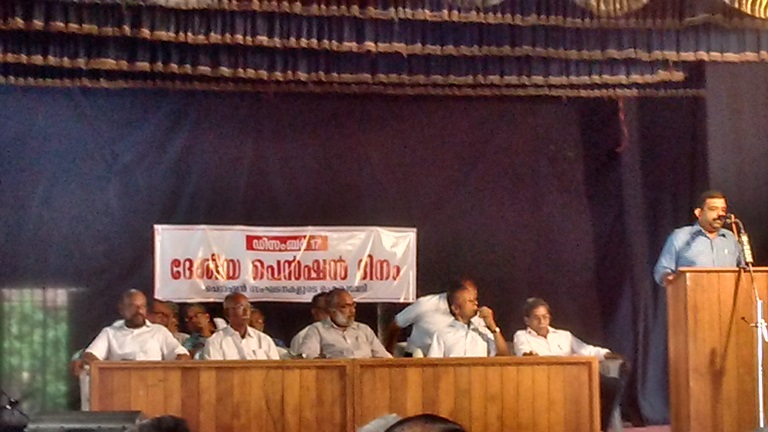
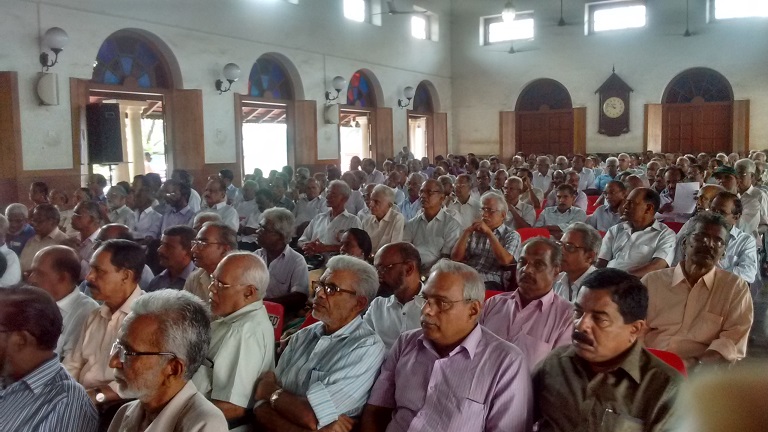
The National Pensioners Day was observed in Kozhikode in a befitting manner on 17-12-2015. This year, Pensioners’ associations of nine sectors viz, Central Govt Pensioners (CGPA), BSNL DOT Pensioers (AIBDPA), Postal & RMS (AIPRPA), LIC (LICPA), Banks (AKBRF), KSEB (KSEBPA), KSRTC (KSRTCPO), Kerala Water Authority (KWAPO), and FCI (FCIPU) joined together in observing the Pensioners Day.A Well attended meeting at the Town Hall, presided by Com Sukumaran Punnassery was inaugurated by Com V Sreekumar (President Confederation of CG Employees, Kerala). Representatives of the participating Associations/ Organizations also spoke on the occasion. Com K Rajan welcomed the gathering and Com E Venugopal proposed vote of thanks.
The following District Branches in Kerala have donated to the Relief Fund.
1.Alappuzha; Rs.2000
2.Palakad; Rs.2000
3.Kollam :Rs.2500.
These amounts were remitted to the bank account of Tamil Nadu Circle.
Three Service chiefs will soon meet Defence Minister to express the forces’ concerns over shortcomings in the recommendations of the 7th Pay Commission
The three Service chiefs will soon meet Defence Minister Manohar Parrikar to express the forces’ concerns over “shortcomings” in the recommendations of the 7th Pay Commission.
The armed forces are of the view that if the Pay Commission is implemented in its present form, it will position them much below their civilian counterparts in terms of salaries, facilities and status.
One of the main grudges that the armed forces have is with regard to the risk-hardship matrix.
The officers say that a soldier posted in Siachen Glacier, the highest battlefield in the world which poses great risk and hardship, will get an allowance of Rs 31,500 per month.
In contrast, a civilian bureaucrat from the All India Services draws 30 per cent of his salary as “hardship allowance” when posted anywhere outside the “comfort zone”.
Under the new scale, a senior IAS official posted in a city in north east India will draw much more as “hardship allowance” when compared to the Rs 31,500 per month that military officers posted in Siachen are to receive.
A total of 869 Indian soldiers have died in Siachen since 1984 due to various factors, including the hostile conditions there.
Navy chief Admiral RK Dhowan was the first among the three service chiefs to officially comment on the Pay Commission report.”
Whatever we feel are the shortcomings are being taken up by the three services with the Ministry of Defence to see that whatever we feel is necessary for our men, our officers, our civilians, is made available to them,” Dhowan had said here on December 3
Under normal circumstances no refund is granted on confirmed, RAC and Waitlisted tickets after the departure of the train.
With effect from 12.11.2015, certain provisions of Railway Passengers (Cancellation of tickets and refund of fare) Rules have been amended and comprehensive Railway Passengers (Cancellation of tickets and refund of fare) Rules 2015 have been notified through Gazette Notification G.S.R. 836(E). dated 04.11.2015.
Important changes made in Railway Passengers (Cancellation of tickets and refund of fare) Rules are as under:-
Refund on cancellation of unused confirmed tickets:
(i) If confirmed ticket is presented for cancellation upto 48 hours before the scheduled departure of the train, per passenger minimum cancellation charge is levied
. (ii). If confirmed ticket is presented for cancellation between 48 hours and upto 12 hours before the scheduled departure of the train, 25% cancellation charges is levied subject to minimum flat cancellation charge.
(iii) If confirmed ticket is presented for cancellation between 12 hours and upto 4 hours before the scheduled departure of the train irrespective of distance, 50% cancellation charge is levied subject to minimum flat cancellation charge.
(iv). Refund on confirmed ticket is granted only upto 4 hours before the scheduled departure of the train.
(B). Refund on cancellation of unused RAC/Wait-listed tickets/Partially confirmed tickets:-
(i). When RAC/Waitlisted ticket/Partially confirmed tickets is presented for cancellation, the refund of fare minus clerkage charge is made upto 30 minutes before the scheduled departure of the train.
Certain provisions of Railway Passengers (Cancellation of tickets and refund of fare) Rules have been amended to check bogus claims, to facilitate provision of Mobile ticketing as well as paperless ticketing, discourage last minute cancellation resulting in seats/berths going vacant etc. The amendment in refund rules became necessary to adapt to changes/developments in the ticketing systems.
Further, reservation charts are being prepared at least 4 hours in advance, which facilitates purchase of available berths till 30 minutes before departure of the train.
No cancellation charge or clerkage charges is levied and full fare is refunded to all passengers holding confirmed, RAC and Wait-listed tickets if the journey is not undertaken due to late running of the train by more than three hours of scheduled departure of the train from the journey commencing station, subject to the condition that the ticket is surrendered prior to the actual departure of the train
This information was given by the Minister of State for Railways Shri Manoj Sinha in a written reply to a question in Rajya Sabha on 11.12.2015.
Dear Comrades,
Com.Sampath Rao Julapally, Circle Secretary, BSNLEU, Andhra Pradesh who took the initiative to host the 2nd triennial All India Conference of AIBDPA at Tirupati along with Com.Ramachandradu, Circle Secretary, AIBDPA, AP have appealed to help Reception Committee by collecting advertisements to the Souvenir.
The Reception Committee under the able leadership of Com. Sampath Rao Julapally is making all out efforts to make the AIC a grand success. We can just imagine the huge expenditure to arrange the accommodation, food and other necessary facilities for about 1000 delegates. Souvenir advertisement is one source of income. An illustrative leaflets with tariff have been despatched to the Circle Secretaries.
CHQ requests all the functionaries and well wishers to co-operate in this endeavour by collecting maximum advertisements and send the order forms and payments to the reception committee without delay.
The tariff for the advertisement is given below;
Back Cover Page; Rs.50,000. 1st Inner cover Page: Rs.50,000, Back Inner Cover Page: Rs.40,000. Colour Full Page: Rs.20,000, Half Page: Rs.10,000, Quarter Page:Rs.5,000 Black & White Full Page: Rs.10000, Half Page: Rs.5,000 Quarter Page: Rs.3,000.
K.G.Jayaraj
General Secretary
A meeting of BSNL DOT pensioners of Fatehpur SSA in UP (East) circle was held at Fatehpur on 03-12-2015 under the presidentship of Com.Lallu Prasasd Mishra. Com.R.K.Dwivedi, Circle Secretary inaugurated the meeting. Com.Babu Lal Pal, District Secretary, BSNLEU addressed. New District Branch was formed with unanimous election of office bearers.
The following are the important functionaries.
President: Com. Lallu Prasad Mishra, District Secretary: Com.Ramakant Sharma and Treasurer: Com. Jamuna Prasad Tiwari.