Author Archives: admin

PRESS STATEMENT ISSUED BY FORUM OF BSNL UNIONS/ASSOCIATIONS ON TWO DAYS STRIKE.


FORUM OF BSNL UNIONS/ASSOCIATIONS

D-7, Telegraph Place, Gole Market, New Delhi – 110001

————————————————————————————————————————–

Press Release                                                                                                                                    20th April 2015

BSNL Employees’ Two Days Strike on 21-22 April 2015 Demanding Revival of BSNL

As per the call of the Forum of BSNL Unions/Associations, the BSNL Employees, both executives and non-executives numbering around 2.25 lakhs, will resort to Two Days Strike on 21-22 April 2015 demanding immediate action from the Government and BSNL Management for the Revival of BSNL.

Bharat Sanchar Nigam Limited was the No.1 telecom company in India and was having an annual  revenue of about Rs.40,000 crore and profit of about Rs 8,000 – 10,000 crore  till 2006. The non-implementation of the government assurances on financial viability, continued cancellation of the BSNL tenders of mobile equipment, confiscation of the cash balance of the company by the government on one pretext or other, discriminating BSNL in favour of private companies -all these deliberate decisions have pushed BSNL in to loss for the last five years.

The government has withdrawn from its assurance to pay ADC, refund of licence fee and liberal subsidy from the USO fund, for compensating BSNL for the loss of about Rs.10,000 crore per year for providing services to the villages and rural areas in the country which is as per the universal connectivity policy of the government. The present loss of the company around Rs. 7,000- 8,000 crore per year will be covered and there will be profit for BSNL if these assurances are honoured and implemented.

Immediate purchase of various equipments for providing mobile, broadband etc. services are most important. Sufficient funds are required for the same, which BSNL is not having at present.

An amount of Rs. 6,700 crore is due to be paid to BSNL by Government towards the cost of spectrum, which the BSNL has surrendered. An amount of Rs. 1,250 crore, allotted to BSNL in lieu of ADC for providing loss making   connections for 2012-13, is still pending payment.  The employees are demanding that these two amounts be paid immediately so that BSNL can purchase required equipment.

The Forum of BSNL Unions/Associations has suggested various proposals for providing better service to the customers on which also no action is taken.

The Forum also demands that BSNL should start 4G services without any delay. It also has demanded that it should be made mandatory for the Central/State Governments and PSUs to take BSNL service as was done in the case of Air India.

The strike Demands submitted by the Forum are mainly intended to improve the services and to better the financial viability of the company. However, neither the Secretary, Department of Telecom nor the Communications  Minister have so far called the Unions/associations for any discussion or settlement of the issues.  The entire responsibility for the strike and its adverse affect on the services and difficulties to the public lies upon the Government and the Management.

The Two Days Strike on 21-22 April will start from the mid-night of 20-21 April 2015. We solicit the support of all in our effort to improve the BSNL services and revive it.

V.A.N.Namboodiri

Convener, Forum

Mobile: 9868231431.

MAY DAY MESSAGE FROM WFTU.

17 Apr 2015
 

The World Federation of Trade Unions (WFTU) on the occasion of the International Workers Day – May 1st 2015 sends a warm militant salute to the international working class and the 90 million organized workers of the WFTU member-organizations in 126 countries of the world.

The International Workers Day is a day of memory and honor to the workers who sacrificed their lives for the rights of the working class, for the abolition of the exploitation of man by man. The struggles of the working class internationally, from the sacrifice of the workers in Chicago in 1886 up to our days, have proven that the working class is not only the creator of the social wealth but also the vanguard, able to lead and rally on its side other oppressed popular strata, in the struggle for the overthrow of capitalism.

The acute and major problems that make the life of the working class difficult continue to exist. The capitalist governments serving the orders of the Capital and the transnational corporations intensify and expand the anti-labor policies: Salary and pension cuts, flexible labor relations, privatizations, destruction of the social security schemes, elimination of trade union rights and liberties and state terrorism. Unemployment, continues to remain and open wound for the working class and continues to attack the rights of the workers. This is the recipe of the world capitalism for the “exit” from the capitalist crisis and the increase of the monopolies’ profit.

In international level the attack by employers and capitalist governments in the right to strike continues in every country but also at international level, within the International Labor Organization. The ILO pushes the issue to the international courts, controlled by the international bourgeoisie and imperialism. This cannot be accepted. The right to strike was not handed over to the workers, but gained by struggles and it can only be defended through the working class’ struggles.

The policies of the international monopoly groups and the competition amongst the imperialist forces has been intensified with disastrous results for the people of the world. The imperialist intervention and the revival of Nazism is to blame for the carnage in Ukraine with thousands of our colleagues as victims.In Syria the imperialist intervention continues. In Venezuela, the US government and the imperialist multinationals promote plans of intervention, destabilization and coup against the democratically elected government. The attacks against the unyielding Cuban people continue with the embargo still in force.

The position of WFTU remains stable and consistent that the workers and the peoples of the world must be the masters in their own countries and free to decide for the present and future of their country without imperialist interventions.

In front of this situation, the World Federation of Trade Unions calls the workers, the international class-oriented trade union movement to organize mass strikes, demonstrations, rallies for the 1st of May in every country of the world, celebrations that will honor the 129 years since the revolt of the workers in Chicago and will project their internationalism and demand contemporary rights for the working class in each country, better wages, labor and trade union rights and liberties, social security, policies to confront unemployment.

Working men and women, youth, unemployed, migrant workers,

The May Day 2015 must be a step forward for the international for the labour and trade union movement in each country, region and sector. We appeal to you to unite your voices with the class-oriented movement in each country, to unite your voices with the voice of the WFTU. With militancy and internationalism we can strengthen our struggle for better working relations, for better living conditions, for a society without exploitation, for a society where the needs of the working class and the people will come first.

Dear brothers, workers, unemployed, pensioners,

This year, in 2015, we celebrate the 70th anniversary since the foundation of the WFTU.Since its creation the WFTU became and continues to be the home, the family, the defender of each workers family.

This common home that we share, this family, let’s honor it by making it stronger everywhere. Let us make WFTU stronger, more militant, more class-oriented, more internationalist, more active, more efficient in every corner of the planet. By strengthening the trade union Organizations in every sector, in all regions, by organizing new members in the trade unions, by building new trade union cadres and more workers leaders, we will move forward.

WITH DETERMINATION – WITH INTERNATIONALISM – WITH STRUGGLES

THE SECRETARIAT


FORUM MEETING EXHORTS TO MAKE THE STRIKE ON APRIL 21-22,2015,A GRAND SUCCESS.

The meeting of Forum of BSNL Unions/Associations held today, the 20th April, 2015 has decided to go ahead with the two day strike on April 21 & 22 as there has been no response from the central government or the Department of Telecom on the strike notice served well in advance for the strike by all the unions of both executives and non executives demanding revival of BSNL. THE MEETING HAS APPEALED TO ALL THE EMPLOYEES AND OFFICERS IN BSNL TO MAKE THE STRIKE COMPLETE AND HISTORIC.

OF COURSE, THIS IS THE FIRST TIME IN THE HISTORY OF INDEPENDENT INDIA,THAT A GOVERNMENT HAS TAKEN  TOTAL CONTEMPT OF THE STRIKE NOTICE SERVED BY ALL THE UNIONS WHICH IS UNDEMOCRATIC AND SO DEPLORABLE. THEREFORE THE BSNL EMPLOYEES HAVE TO RISE TO THE OCCASION TO SEE THAT A FITTING REBUFF IS GIVEN TO THE GOVERNMENT BY MAKING THE STRIKE FULL.

TRAI PROPOSES EXEMPTION OF LICENCE FEE FOR LANDLINE BROADBAND.


The proposal of the TRAI to exempt licence fee for the broadband based on landline is a correct step.  The landlines are mostly loss-making or with hardly any profit. Under such circumstances, universal service by land-lines becomes difficult. If licence fee is exempted companies will be able to provide more landlines and promote broadband.

Further this will benefit BSNL, which is the leader in the landlines and hold the majority market share.


VELLORE DISTRICT CONFERENCE HELD-IDEAL IN MANY COUNTS.

Vellore District Branch, one of the big and strong districts in Tamilnadu,  held its Conference in a befitting manner with great enthusiasm on 19th April, 2015. Com. V. Elumalai, District President controlled the proceedings. Com. Jothi Sudanthiranathan, District Secretary welcomed the gathering. Com. S. Mohandoss, CHQ Vice President & Circle President inaugurated the conference covering all the issues. Com. C. K. Narasimhan, Circle Secretary delivered a special address. Coms. K. Arumugam, CHQ Org Secretary, C.Gnanasekharan, Circle Org Secretary , N.Kuppusamy, District Secretary, Erode and a host of leaders from pensioners organisations of bank, LIC, Postal and State government addressed the conference. District Secretary, BSNLEU greeted the conference.

Six senior comrades who have crossed 75 years were honoured with presentation of shawls. 15 family pensioners were presented with Rs. 1000 each by Com. C. K. Narasimhan, Circle Secretary. There was a massive participation of more than 200 pensioners.

The report and audited accounts presented by Com. Jothisudanthiranathan, District Secretary and Com.P. Sridhar, Treasurer respectively were adopted after discussion.

 Office bearers were elected unanimously with Com. V. Elumalai (President), Jothisudanthiranathan (Secretary) and Com. P. Sridhar (Treasurer)


MINIMUM WAGE SHOULD BE Rs.26,000-NJCM DEMANDS 7TH PAY COMMISSION.


In the Memorandum submitted to 7th pay commission, the NCJCM demanded the pay commission that the   minimum Pay should be fixed at Rs.26000/-. Detailed information with statistical data has been provided in the report for justifying the demand to fix Minimum wage at Rs.26000/-. It appears that NCJCM is firm on its claim for minimum wage.  In the Meeting held recently with NCJCM , the 7th pay commission confronted with the price quoted for essential commodities by NCJCM. Hence the NCJCM asked its affiliates to obtain price list from all the Metros to establish their claim on price is correct, so that the minimum wage can be arrived as per Dr. Dr. Aykhrod formula to Rs.26000/-. The Chapter V of the NCJCM’s Memorandum submitted to 7th pay commission describes the need and reasons for minimum wage to be assigned at Rs.26000.

Chapter V
Minimum Wage

     All the Pay Commissions were of the firm opinion that wages cannot be determined on any single principle but has to be based upon a combination of all the enunciated principles or those principles are to be factored into the process of quantification. Since the Government as an employer had not been able to grant the need based minimum wage to its own employees till date we are of the firm opinion that the 7th CPC must endeavour to compute the wage structure on 15th ILC norms. We suggested two other principles to be factored into the quantification of pay beyond the minimum level.  We enumerate hereunder the factors to be taken into account:

(1) The Need-Based Minimum Wage concept to compute pay at the minimum level.

(2) The intrinsic value of the job content of each grade and post at the intermediary level to be assessed by an expert committee. Pending finalization of such a study, the Commission may maintain the presently existing vertical and horizontal relativities.

(3) To take into account the outside rates to determine the pay package at senior levels of bureaucracy but maintain the ratio between the minimum and maximum at 1 : 8 (MTS to Secretary to Govt. of India).

5.2. We make the above suggestions as just and reasonable on the following grounds:

(1) The Fair Wage Committee has held that an industry which is incapable of paying minimum wage has no right to exist.

(2) 88% of Central Government Employees are industrial or operational workers.

(3) The need based minimum wage concept formulated by Dr. Aykroyd and approved by 15th ILC was considered the most important principle in computing salary of Government employment especially of lower level functionaries, by the 2nd, 3rd, 4th and 6th CPC.

(4) It is only the fear of a heavy financial implication and the incapacity of the Indian economy at the relevant point of time, to meet the extra expenses that the 2nd, 3rd and 4th CPCs were constrained to alter the formula itself, detrimental to the interest of employees, basing their conclusion on the opinion of certain nutritional experts. The legitimacy provided to Dr. Aykroyd formula by the 15th ILC (in which the representative of Labour, Employers and Government participated) was not available for any other conceptual frame work proposed by any other “experts”. The 4th Pay Commission cited the per capita net national product increase over the years to justify lower minimum wage than what could have been as per the ILC norms. It could be seen that the earlier Pay Commissions had adopted a different principle other than the Dr. Aykroyd formula due to financial constraints.

(5) Despite elaborately detailing the concept of living wage and the purport and relevance of the amendment to the preamble of the Indian Constitution, the 4th CPC did not compute the pay structure on the basis of need based minimum wage formula. They stated that since the increase in the per capita net national product is an indication of the health of economy, they may be unable to fix the minimum wage at an amount higher than Rs.750/-.

(6) There had been no indication in the terms of reference by which the 5th CPC could have examined the need based minimum wage concept evolved by the 15th ILC. Still they dwelt upon the said concept in detail in their report. In fact they advocated that the 25% addition suggested by the Supreme Court to enable the worker to meet the expenses, viz., children education, medical requirements, social obligation connected with festivals, marriages, etc. must be added to arrive at the minimum wage. However, while computing the minimum wage, they discarded the theory of Need based Minimum wage. They adopted the percentage increase over ten years of the per capita net national product as the sole criterion to determine the minimum pay. (In other words they advocated the constant relative income criterion as the most equitable norm for fixing the minimum wage of the Central Govt. employees.). In order to arrive at the minimum pay, the Commission thus added 30.9% over the emoluments of a lowest paid employee as on 1.1.1996

(7) The 6th CPC adopted the 15th ILC norms to compute the minimum wage but made several changes to the concept Viz., the retail prices of the commodities which goes into the reckoning was altered; the stipulated 10% for housing and 25% for social obligations, medical, children education, etc. were discarded on the specious plea that separate allowances had been granted. 15th ILC had factored 7.5% as housing component in the computation of minimum wage. The question of incorporating the cost of requirement for medical, education and other social obligation was the subject matter of litigation before the Supreme Court. The Hon’ble Court directed that 25% of the minimum wage so computed must be added as a factor for the above requirement of a worker, which had not been taken into account in the ILC norms.

5.3 The contention of the 6th CPC that since children education allowance, Medical and house rent allowances are specially granted to the Central Govt. employees, the same must be taken out of the reckoning is not only wrong but also amounts to contradiction of a stand taken by the Highest judiciary of the country- Supreme Court. The 6th CPC has failed to take note of the fact that the allowances, be it HRA, Children Education allowance or Medial, granted are awfully insufficient to meet the requisite expenses. Had it not been the case, the 3rd CPC also ought to have taken the similar stand adopted by the 6th CPC. The computation appearing in page No. 60, Chapter 6 (3rd CPC report) establishes our view in the matter. We have given in Table (5.1) the computation of minimum wage as per 15th ILC norms. The retail prices of the commodities/articles are the average of the retail prices ruling as on 1.1.2006 at the following cities:

1, New Delhi. 2. Mumbai, 3 Chennai, 4., Kolkata , 5. Hyderabad, 6. Bhubaneswar, 7. Trivandrum and 8. Bangalore.

5.4 The minimum wage as per our computation works out to Rs.20,861/-. This must be the minimum wage for the unskilled worker as per the ILC norms. In Central Government employment presently there are no unskilled labour. The lowest level of employment is multiskilled worker/employee. The minimum educational qualification prescribed is either ITI or matriculation (10th Standard). The percentage increase of the wages of a skilled worker to that of an unskilled worker on an average had been more than 25% all throughout (2440-3050=610 i.e. 25% of Rs. 2440) We have therefore added 25% to arrive at the minimum pay for the lowest employee in Government service, which comes to Rs. 26,075/- , i.e. Rs. 26,000/- when rounded off. While computing the minimum wage, we have gone strictly as per the norms prescribed by the 15th ILC. However, we must state that the three units norm for the family prescribed by Dr. Aykroyd in the present situation is far below the requirement. The family consists of not only husband, wife and two children but invariably includes the parents of the head of the family. In Indian conditions, they totally depend upon the earning employee. If we factor two more units for the family concept, the minimum wage so worked out will increase by two third. In quantum terms, the pay at the lowest level of the Central Government will then be Rs. 43,330.

Table 5.1

PRICES OF THE INGREDINTS SPECIFIED IN TEH 15TH ILC TO CALCULATE THE MINIMUM WAGES AS ON 01.05.2014
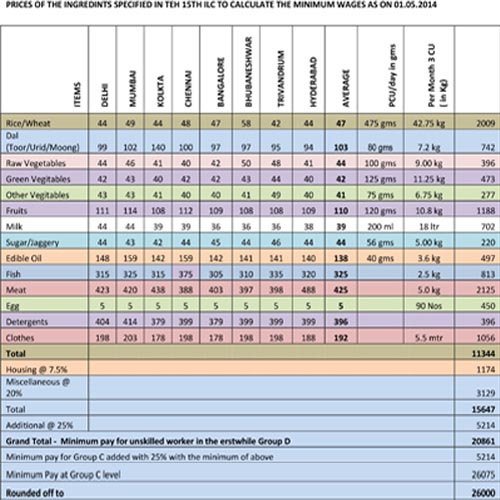
7th pay commission minimum wage Rs.26000

7th pay commission minimum wage Rs.26000

20% of the net minimum miscellaneous charges towards fuel, electricity, water charges, etc

Housing at the rate of 7.5% of net minimum

Addition Expenditure at the rate of 25% includes expenditure towards education, marriage etc of the children, Medical treatment, recreation, festivals etc. as per the Supreme Court decision in 1991.

5.5. Incidentally, we may mention that the minimum wages at the level of an unskilled worker as per recent wage agreement in Coal India Ltd. is Rs.29697/-. as per details given hereunder

(Table 5.2.)

Basic Pay   Rs. 15, 712
Dearness allowance 29.6%  
Special allowance 4.0%  
Special DA. 1.795%  
Attendance bonus 10%  
Total: 49.395% Rs. 7132.46
Total salary:   Rs.22844.46
At the MTS level 22.844.46 x 125% Rs.28555.58


5.6 The per-capita Net National Product increase at factor cost between – (2004-05 – 2011-12) years as per the Economic Survey for 2012-13 presented to Parliament is 57.55..%. The exact figures for the years 2012-13 and 2013-14 is not available from official websites. These figures are needed to arrive at a percentage of increase for the last 10 years. On the basis of the present data, the increase registered in quantum terms will work out to Rs. 22857, which is more than the minimum wage computed as per the 15th ILC norms.

(Table 5. 3)

A. Per Capita NNP at constant price for 2004-05 Rs. 24,143
B. Per capita NNP at constant price for 2011-12 Rs. 38,037
C. The increase registered over 8 years. Rs. 13,894
D.  Percentage increase over 2004-05 57.54877
E. Emoluments as on 1.1.2014 Rs. 14,000
F. 57.55% of Rs. 14,000. Rs. 8,057
G Wage to be fixed as on1.1.14 Rs. 22057


5.7. For the reasons stated in the preceding paragraphs and more specifically for the reason that the Government has presently the capacity to pay as detailed in Chapter III of this memorandum, we request the 7th CPC to recommend the minimum pay to be assigned to the lowest level of Group C functionary in Government of India service at Rs. 26,000/-



SUPPORT THE TWO DAYS STRIKE IN BSNL ON 21-22, APRIL, 2015.

THE TWO DAYS STRIKE IN BSNL ON 21-22, APRIL, 2015 BY THE FORUM OF BSNL UNIONS/ ASSOCIATIONS IS A DO OR DIE BATTLE TO PROTECT BSNL. 2.5 LAKH WORKERS BOTH EXECUTIVES AND NON EXECUTIVES ARE DETERMINED TO GO FOR THE STRIKE AS NO FRUITFUL DISCUSSION HELD TO AVERT THE STRIKE. THOUGH THE STRIKE NOTICE WAS SERVED LONG BEORE AND SEPERATE LETTERS SENT TO THE PRIME MINISTER AND THE COMMUNICATIONS MINISTER, THE APPROACH OF THE GOVERNMENT AND THE COMMUNICATIONS MINISTER TO IGNORE IT IS TO BE PROTESTED AND CONDEMNED. THE MAIN DEMAND FOR THE STRIKE IS TO REVIVE BSNL BY EXTENDING NECESSARY HELP BY THE GOVERNMENT TO MAKE IT VIABLE AND ENSURE BETTER SEVICE TO THE CUSTOMERS.

ALL AIBDPA UNITS ARE REUESTED TO SUPPORT THE STRIKE BY ALL MEANS AND ALSO ORGANISE SOLIDARITY ACTION.

MEETING OF BSNL MANAGEMENT WITH BSNL CCWF ON STRIKE ISSUES FAILS.


The BSNL Management held a meeting with the representatives of BSNL Casual and Contract Workers Federation(BSNLCCWF) on 17th April 2015 on the demands raised by the Federation in its strike notice.

Shri Anupam Shrivastava, CMD BSNL, Smt. Sujata Ray (ED Finance), Shri Shameem Akthar, Sr GM(SR), Ms. Madhu Arora, GM( Estt.), Shri  A.Sinha, GM(Admn) and Shri S.S.Agarwal, GM(Pers) attended from the Management. The BSNLCCWF was represented by Coms. V.A.N.Namboodiri, President, Tapas Ghosh, Secretary General BSNLCCWF and Swapan Chakraborty, Dy.GS BSNLEU.

All the issues including regularisation of casual/contract workers, wages, EPF, ESI, Gratuity and other issues were discussed in detail. The leaders strongly demanded for the implementation of the labour laws, minimum wage, EPF, ESI etc.

There is not much improvement on the issues. Hence prepare for the strike in an effective way. Make all joint preparations with BSNLEU and Forum.


WFTU RELEASES MAY DAY POSTER.

Poster of the WFTU in honour of the International Workers Day on 1st May 2015 has been released. Members and friends are encouraged to circulate the poster, print it and use it in all public events for the day.

2015_May Day
2015_May Day
File name: 2015_May Day_Poster_WFTU_En_s.pdfDocument Requirments:

April 14, 2015
1.4 MiB
130 Downloads

INDIAN RAILWAYS COMPLETE 162 YEARS OF SERVICE TO THE NATION.


Indian_Railway.svg

It is a creditable record. Indian Railways is completing 162 years of glorious service. It was on 16th April 1853 that the first train started from Victoria Terminus (Bombay) to Thane. It has grown and grown.

Indian Railways is one of the largest railways in the world with 115,000 km of track over a route of 65,436 km and more than 7,200 stations. In 2014-15, IR carried 8.397 billion passengers annually or more than 23 million passengers a day (roughly half of whom were suburban passengers) and 1050.18 million tons of freight in the year. In 2014–2015 Indian Railways had a revenue of Rs.1634.50 billion which consists of Rs.1069.27 billion  from freight and Rs. 402.80 billion from passengers tickets.

It is also the biggest employer in the country with more than 13 lakh workers.

The move of the government to privatise the Indian Railways should be strongly opposed.