Author Archives: admin

Suspension of Kerala Comrades revoked – Congratulations!


Orders have been issued by BSNL Kerala Circle revoking the suspension  all the 20 union office-bearers and activists of BSNLEU and SNEA, who were put under suspension in connection with the agitation for the demands of the Casual and Contract labours as also against the corrupt practices of the then CGM MSS Rao. The orders are with immediate effect. BSNLEU, SNEA and BSNLCCWF have been pursuing the case continuously.

Congratulations to Kerala Comrades!

CENTRAL EXECUTIVE COMMITTEE MEETING OF BSNLEU ON 24-25,NOVEMBER,2015 IN NEW DELHI.

The Central Executive Committee Meeting of BSNL Employees Union is being held in New Delhi on 24-25, November, 2015. The CEC will be inaugurated by Com.K.Hemalata, National Secretary, CITU. A seminar on ‘ Revival of BSNL’ is also arranged in connection with the CEC and the participants include Shri. Anupam Shrivatava, CMD, Ms.Sujatha Ray, Director (HR),BSNL.

AIBDPA wishes the CEC all success.

NCCPA CIRCULAR ON 7TH PAY COMMISSION RECOMMENDATIONS AND OBSERVANCE OF BLACK DAY ON 27-11-2015


NATIONAL CO-ORDINATION COMMITTEE OF PENSIONERS ASSOCIATIONS
New Delhi.
Website address:nccpahq.blogspot.in.
E mail address:nccpahq@gmail.com.
Dated: 21st November, 2015
Dear Comrades
                We hope you must have gone through the gist of the 7th CPC recommendations, which we have placed on our website on 20th.  We reproduce hereunder a copy of the Press Statement issued by the Convenor, National JCA, Com. Shiv Gopal Misra immediately after the submission of the report by the commission to the government.  We are in full agreement with the views expressed therein and endorse the same.  In fact from every facet, this report must be characterized as the worst attempt of wage revision for Central Government employees.    The increase in the wages after 10 years is just 14.28%, whereas it was much more in the case of Bank and Insurance Employees whose wage revision takes place every five years.  We have every reason to believe that the present Government has exerted pressure on the Commission to suppress the wage package of the Central Government employees.  It had been our repeated plea that the Commission should not be loaded with bureaucrats drawn from the Government for it is our experience right from the 5th CPC onwards that their presence has influenced the Commission’s recommendations.   No different is the story of the 7th CPC.  The bureaucrats in the Group ‘A’ cadres have immensely benefited from this Commission’s report.  The ratio between the minimum and maximum, as per the 7th CPC recommendation is 1:14, even beyond what the 6th CPC recommended.    It could be seen that none of the demands which the Central Government employees jointly placed before the Commission has been accepted.  There is no reasoning advanced by them to substantiate the rejection.   Most of the issues have been dealt with in a manner of an arbitrator. In order to suppress the wages, the doctrine and formula of minimum wage has been distorted by the Commission.  They have taken the average of 12 months ( July, 2014 to June, 2015) prices of the commodities, which the formula does not stipulate at all.  The minimum wage has to be on the basis of the retail prices of the commodities on a particular date.  The rates are sourced from the Labour Institute, Simla, whose credentials of adoption of the actual rates had been dubious all along.  The Ministry of Agriculture in their website publishes the monthly rates of commodities.  We have worked out the minimum wage taking the average rate of 8 cities as on 1.11.2015.  Even according to those rates, which the Government cannot dispute, the minimum wage comes to Rs. 26000 +. Fitment formula and every other allowances depend upon the minimum wage.    The pay scales are constructed on the premise of the minimum wage. The issue has to be fought out.   We hope the meeting of the leaders of the organizations participating in the JCM scheduled to be held on 8th December, 2015 will take the decision to go ahead with the strike preparation.  That alone will make the negotiation, if at all it takes place, meaningful and fruitful.
                Coming to the issues concerning the Pensioners, you must have seen that except in the case of parity, there is no positive recommendation emanated from this Commission.  Every pensioner had expected a rise in the FMA as it is presently pegged down to a meagre amount of Rs. 500.  The Government had agreed to revise the additional pension for those beyond the age of 75.  The 7th CPC has even rejected it on the advice of the Defense Ministry.  We are at a loss to understand that what authority the Defense Ministry has got in this matter.
                We shall have to prepare a charter of demands to be presented to the Government through the Staff Side JCM as also directly. We, therefore, request all our comrades, to go through the recommendations and make suggestions for improvement so as to help the Sectt. to formulate the demands.   Kindly bear in mind that the demands which we propose to include in the charter must be such which has universal coverage.
                We must join the Protest Day on 27th November, 2015, being organized by the working employees.  Every State Committee and affiliate may decide upon a particular venue in each State Capital and join the demonstration by wearing the black badges. 
                Please print the following on the badges:
Protest Day 27.11.2015
We protest against the most retrograde  recommendations
Of the 7th  CPC.
Demand the Government to negotiate and revise the minimum wage and settle the issues.
            With greetings,
                                                                                                                          Yours fraternally,
                                                                                                                           K.K.N.Kutty
                                                                                                                           Secretary General

BLACK DAY AGAINST RETROGRADE 7TH PAY COMMISSION REPORT ON 27-11-2015- AIBDPA TO JOIN.


JCM Staff Side (NJCA) has called upon all Central Government Employees to observe “BLACK DAY” by holding massive demonstration, wearing black badges, all over the country on 27th November 2015 to protest against the retrograde recommendations of the 7th CPC.

AIBDPA fully endorses the decision and request all units to participate enmasse in the protest action

Know Easy steps to Calculate your 7th Pay Commission New Pay Scale


7th Pay commission simplified the calculation for arriving revised Pay through new 7th CPC Pay Metrix


We here illustrate the method through easy 6 Steps to calculate our 7th CPC New Pay and Allowances to know your self

Lat us Assume you are drawing Grade Pay Rs.4200 and Pay in the Band Pay Rs.12110

To calculate your Basic Pay and Allowance follow the steps given below.

Step-I

Calculate your sixth CPC basic Pay                    ( Grade Pay + Band Pay)   = 4200+12110= 16310

Step-II   

Multiply the above figure with 7th CPC Fitment Formula 2.57 16310 x 2.57 = 41916.70 . ( Paisa to be rounded off to the nearest Rupee)                            The Ans is = Rs.41917

Step-III

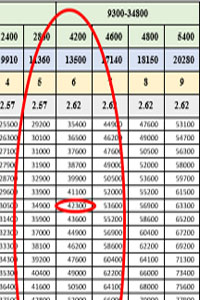
Match this Answer with Matrix Table ( Given Below) Figures assigned in Grade Pay column Rs.4200

7th CPC new PayScale

7th cpc new pay matrix

There is no matching figure we arrived above in this matrix, so the closest higher figure assigned in the Grade Pay column can be chosen ie is Rs. 42300

So , Rs 42300 is your New 7th CPC Basic Pay

Step-IV

Identify your HRA [ See : 7th Pay commission recommendation on HRA]

HRA has been revised as 24%, 16% and 8% for 30% , 20% and 10% respectively

So if you are in 30% HRA Bracket, your HRA in 7th CPC is 24% vis versa.

Let us assume now you are in 30% HRA bracket, your revised HRA is 24%

Find the 24% of the Basic Pay  =   42300 x 24/100 = 10152

 Your HRA is Rs.10152

Step-V

Identify your TPTA (Transport Allowance)

7th CPC Recommends Transport Allowance for three Category of Employees for Two Types of Places

If you are living in A1 and A classified cities (See the List of 19 cities classified as A1 and A cities) you will be entitled to get higher TPTA rates

7th cpc TPTA Transport Allowance

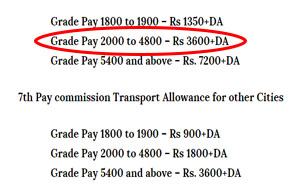
And since your Grade Pay is 4200 you fall in Second category

ie Grade Pay 2000 to 4800 – Rs 3600+DA

Your TPTA is Rs. 3600/- (DA is Nil as on 1.1.2016)

Step-VI

(Sine DA will be Zero from 1.1.2016 So no need to calculate the DA to calculate 7th Pay and Allowances from 1.1.2016)

Add all the figures 

New Basic Pay + HRA+TPTA = 42300+10152+3600 = 56052

 Your revised 7th CPC Grass pay as on 1.1.2016  =  Rs.56052


CONFEDERATION CALLS PROTEST DEMONSTRATIONS AGAINST RETROGRADE RECOMMENDATIONS OF 7TH PAY COMMISSION- AIBDPA FULLY ENDORSES THE DECISION.

7TH PAY COMMISSION REPORT SUBMITTED TO GOVERNMENT OF INDIA ON 19.11.2015


MOST DISAPPOINTING AND RETROGRADE RECOMMENDATIONS
WORST RECOMMENDATIONS EVER MADE BY ANY PREVIOUS PAY COMMISSION
ONLY 14.29% INCREASE IN PAY AFTER 10 YEARS
(EQUAL TO TWO DA INSTALLMENTS)!!!


50 LAKHS CENTRAL GOVERNMENT EMPLOYEES AND DEFENCE PERSONNEL CHEATED & DECEIVED


HOLD PROTEST DEMONSTRATIONS ALL OVER THE COUNTRY


NJCA LEADERS MEETING AT DELHI ON 20.11.2015 AT 11 AM, WILL DECIDE THE FUTURE COURSE OF ACTION
IMPORTANT RECOMMENDATIONS
DATD OF EFFECT – 01.01.2016
JCM Staff Side demand – 01.01.2014 – Rejected
MINIMUM PAY – 18000
JCM (SS) demand – 26000 – Rejected
Dr. Aykroyd Formula of 15th Indian Labour Conference for calculation of Minimum wage distorted by 7th CPC to deny the eligible minimum pay.
FITMENT FORMULA – 2.57 TIMES
JCM (SS) demand – multiplication factor 3.7 (26000/7000)
FIXATION ON PROMOTION – NO CHANGE – ONLY ONE INCREMENT IN THE OLD SCALE
JCM (SS) demand – Minimum two increments fixation.
 ANNUAL INCREMENT – 3% NO CHANGE
JCM (SS) demand – 5%
 MODIFIED ASSURED CAREER PROGRESSION – NO CHANGE – 10, 20, 30
Conditions made more stringent. Bench mark “Very Good” required instead of “good”. Examination for MACP proposed. Hierarchial promotion restored.
JCM (SS) demand: Five promotion – 8,7,6,5,4 (30 years)
PAY BAND, GRADE PAY SYSTEM ABOLISHED
New Pension Structure called “Matrix based open ended pay structure” recommended. Total span of the scale 40 years.
JCM (SS) demand: Abolish pay band, Grade Pay system and open ended pay scales should be introduced.
MAXIMUM PAY INCREASE – 14.29%
JCM (SS) demand – Minimum 40% increase for all employees.
9.                COMPARISON BETWEEN MINIMUM AND MAXIMUM PAY – 1:11.4 (18000 : 205400)
Demand of the JCM (SS) – 1:8NUMBER OF PAY SCALES – NOT REDUCED – NO DELAYERING
JCM(SS) demand – pay scales with grade pay 1900, 2000, 4600, 8700 and the pay scale 75500-80000 to be abolished
ALLOWANCES – NO IMPROVEMENT
Commission recommended abolition of 52 existing allowances such as Assisting Cashier Allowance, Cash Handling Allowance, Treasury Allowance, Handicapped Allowance, Risk Allowance, Savings Bank Allowance, Special compensatory (Hill Area) Allowance, Cycle Allowance, Family Planning Allowance etc.
HRA REDUCED TO 24%, 16% AND 8% FOR X, Y AND Z CITIES
JCM (SS) demand – Existing HRA of 30% (for X class cities with population 50 lakhs and above), 20% (for Y class cities with population of 5 lakhs to 50 lakhs) and 10% (for Z class cities with less than 5 lakhs population) may be increased to 60%, 40% and 20%.
DRIVERS – HIGHER PAY SCALE REJECTED
14.          DA FORMULA – NO CHANGE
HBA – NO CHANGE – CEILING RAISED TO 25 LAKHS
CASUAL LEAVE – NO INCREASE
CHILD Care Leave
1st 365 days – Full pay (100%)
Next 365 days – 80% Pay only.
MATERNITY LEAVE – NO CHANGE 
19.          LEAVE ENCASHMENT AT THE TIME OF RETIREMENT – NO INCREASE MAXIMUM 300 DAYS ONLY
20.          MEDICAL
Medical Insurance Scheme for serving and retired employees recommended.
21.          TRANSPORT ALLOWANCE – NO HIKE –  ONLY 125% MERGER
Pay Level
Higher  Transport Allowance cities (A, AI)
Other places
9  and above
7200 + DA
3600  + DA
3  to 8
3600 + DA
1800  + DA
1  and 2
1350 + DA
900  + DA
LEAVE TRAVEL CONCESSION (LTC) – NO CHANGE
One time LTC to Foreign Country during the service rejected. Splitting of Home Town LTC for employees Posted in North East, Laddakh, Andaman & Nicobars and Lakshdweep allowed.
23.          ACCOUNTS STAFF BELONGING TO UNORGANIZED ACCOUNTS – PARITY WITH ORGANISED ACCOUNTS REJECTED.
24.          PERIODICAL REVIEW OF WAGES (NOT TEN YEARS) RECOMMENDED. NO PAY COMMISSION REQUIRED
25.         PERFORMANCE RELATED PAY SHOULD BE INTRODUCED IN GOVERNMENT SERVICES AND ALL BONUS PAYMENT SHOULD BE LINKED TO PRODUCTIVITY.
JCM (SS) demand – No Performance related Pay. Productivity Linked Bonus for all.
26.          COMPULSORY RETIREMENT AND EFFICIENCY BAR REINTRODUCED
Failure to get required bench mark for promotion within the first 20 years of service will result in stoppage of increment. Such employees who have out lived their ability, their services need not be continued and the continuance of such persons in the service should be discouraged.
27.          PROMOTEE AND DIRECT RECRUITS – ENTRY LEVEL PAY ANOMALY IS REMOVED
JCM (SS) demand – the differential entry pay between new recruits and promoted employees should be done away with.
28.          CADRE REVIEW TO BE COMPLETED IN A TIME BOUND MANNER.
Commission recommended to hasten the process of cadre review and reduced the time taken in inter-ministerial consultations.
29.          NEW PENSION SCHEME – WILL CONTINUE
30.          CEA & HOSTEL SUBSIDY
Rate
CEA per month             2250 – 25% increase when DA crosses 50%
Hostel subsidy              6750 – 25% increase when DA crosses 50%
31.          GROUP INSURANCE SCHEME
Level                    Monthly Contribution           Insurance Amount
1 to 5                   1500                                       15 Lakhs
6 to 9                   2500                                       25 lakhs
10 and above      5000                                       50 lakhs
PENSIONARY BENEFITS
32.          PENSIONERS – PARITY – LONG STANDING DEMAND OF THE PENSIONERS ACCEPTED
Commission recommends a revised Pension Formulation for Civil employees and Defence Personnel who have retired before 01.01.2016. (expected date of implementation of seventh CPC recommendations). This formulation will bring about complete parity of past pensioners with current retirees.
33.          PENSIONERS – MINIMUM PENSION RS. 9000/-
(50% of the minimum pay recommended by the 7th CPC)
34.          PENSIONERS – GRATUITY CEILING RAISED TO 20 LAKHS
35.        PENSIONERS – FIXED MEDICAL ALLOWANCE (FMA) – NO CHANGE (RS. 500/-)
36.          CGHS FACILITIES TO ALL POSTAL PENSIONERS RECOMMENDED
33 Postal dispensaries should be merged with CGHS
37.          GRAMIN DAK SEVAKS (GDS) OF THE POSTAL DEPARTMENT DEMAND FOR CIVIL SERVANTS STATUS REJECTED
Recommendation: – The committee carefully considered the demand for treating the Gramin Dak Sevaks as civil servants at par with other regular employees for all purposes, and noted the following:
GDS are Extra-Departmental Agents recruited by Department of Posts to serve in rural areas.
As per the Recruitment Rules the minimum educational qualification for recruitment to this post is class X.
GDS are required to be on duty only for 4 to 5 hours a day under the terms and conditions of their service.
The GDS are remunerated with Time Related continuity Allowance (TRCA) on the pattern of pay scales for regular Government employees plus DA on pro-rata basis.
A GDS must have other means of income independent of his remuneration as a GDS to sustain himself and his family.
Government of India has so far held that GDS is outside the Civil Service of the Union and shall not claim to be at par with the Central Government Employees. The Supreme Court Judgment also states that GDS are only holder of Civil posts but not civilian employees. The Commission endorses this view and therefore has no recommendation with regard to GDS.
(M. Krishnan)
Secretary General

7th CPC Recommends Transport Allowance for three Category of Employees for Two Types of Places


Transport Allowance (TPTA) is granted to cover the expenditure involved in commuting between place of residence and place of duty.

7th CPC Recommends  Transport Allowance for three Category of Employees for Two Types of Places

7th Pay commission Transport Allowance for Higher TPTA Cities (19 Cities Covered)

          Incidentally, only 13 cities fall under this categorization: six in A1, viz., Hyderabad, Delhi, Bengaluru, Greater Mumbai, Chennai, Kolkata and seven in A, viz., Ahmedabad, Surat, Nagpur, Pune, Jaipur, Lucknow and Kanpur. Recently, six more cities, viz., Patna, Kochi, Kozhikode, Indore, Coimbatore and Ghaziabad have been added to A1/A categories, making it nineteen in all.

Grade Pay 1800 to 1900 – Rs 1350+DA Grade Pay 2000 to 4800 – Rs 3600+DA Grade Pay 5400 and above – Rs. 7200+DA

7th Pay commission Transport Allowance for other Cities

Grade Pay 1800 to 1900 – Rs 900+DA Grade Pay 2000 to 4800 – Rs 1800+DA Grade Pay 5400 and above – Rs. 3600+DA

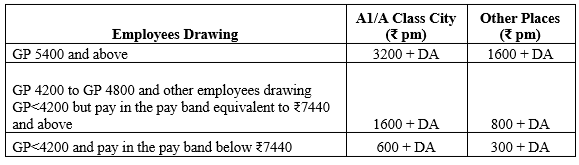
The existing rates are as under

7th CPC Transport Allowance

The Commission notes that TPTA is fully DA-indexed.

The first issue to be considered is whether the rate of Transport Allowance should be the same for all places. There are arguments both for and against this view.

Proponents of the idea argue that petrol prices are almost same everywhere. Moreover, public transport system is better developed in many of the A1/A Class cities, thereby reducing the cost of commuting significantly. The argument, therefore, is that A1/A category places do not need to have a higher rate.

Opponents point out that the categorization of A1/A has been abolished for other purposes (like HRA, CCA) but retained for Transport Allowance. Incidentally, only 13 cities fall under this categorization: six in A1, viz., Hyderabad, Delhi, Bengaluru, Greater Mumbai, Chennai, Kolkata and seven in A, viz., Ahmedabad, Surat, Nagpur, Pune, Jaipur, Lucknow and Kanpur. Recently, six more cities, viz., Patna, Kochi, Kozhikode, Indore, Coimbatore and Ghaziabad have been added to A1/A categories, making it nineteen in all. (Incidentally, vide a recent notification No. 21(2)/2015-E.II(B) dated 06.08.2015, the use of term “A1/A” has been dropped for these nineteen cities. Hence, the Commission will refer to these nineteen cities as “Higher TPTA cities.”). In all these places the commuting distances are far more than in other cities. Moreover, the public transport system is not as developed as it should be in all these places. Therefore, it is argued, the distinction should remain.

After considering both the viewpoints, the Commission is of the view that by and large the commuting distances and associated difficulties involved in Higher TPTA cities are much more compared to other places. Hence, the argument that the distinction should stay is a valid one.

The second issue is whether Transport Allowance should be the same for all personnel posted at the same place. Here the Commission feels that a question of status of employee is involved and hence, complete parity is not possible.

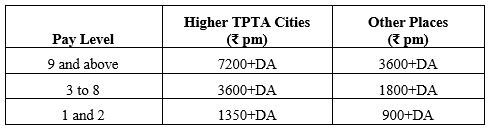
Regarding the optimal rate of Transport Allowance, the Commission notes that the allowance is already fully DA indexed. Therefore, since DA has already reached 119 percent and is likely to rise further before the implementation of our report, the following rates of Transport Allowance are recommended:

7th CPC Transport Allowance recommended

Officers in Pay Level 14 and higher, who are entitled to the use of official car, will ave the option to avail themselves of the existing facility or to draw the TPTA at the rate of ₹15,750+DA pm. Differently abled employees will continue to be paid at double rate, subject to a minimum of ₹2,250 plus DA

7th CPC Fitment Formula and Pay Fixation in the New Pay Structure

Fitment Formula is 2.57

This fitment factor of 2.57 is being proposed to be applied uniformly for all employees

Actual hike in the basic pay is 14.29 %

Fitment


5.1.27 The starting point for the first level of the matrix has been set at ₹18,000. This corresponds to the starting pay of ₹7,000, which is the beginning of PB-1 viz., ₹5,200 + GP 1800, which prevailed on 01.01.2006, the date of implementation of the VI CPC recommendations. Hence the starting point now proposed is 2.57 times of what was prevailing on 01.01.2006. This fitment factor of 2.57 is being proposed to be applied uniformly for all employees. It includes a factor of 2.25 on account of DA neutralisation, assuming that the rate of Dearness Allowance would be 125 percent at the time of implementation of the new pay. Accordingly, the actual raise/fitment being recommended is 14.29 percent.

Pay Fixation in the New Pay Structure

5.1.28.  The fitment of each employee in the new pay matrix is proposed to be done by multiplying his/her basic pay on the date of implementation by a factor of 2.57. The figure so arrived at is to be located in the new pay matrix, in the level that corresponds to the employee’s grade pay on the date of implementation, except in cases where the Commission has recommended a change in the existing grade pay. If the identical figure is not available in the given level, the next higher figure closest to it would be the new pay of the concerned employee. A couple of examples are detailed below to make the process amply clear.

5.1.29 The pay in the new pay matrix is to be fixed in the following manner: Step 1: Identify Basic Pay (Pay in the pay band plus Grade Pay) drawn by an employee as on the date of implementation. This figure is ‘A’. Step 2: Multiply ‘A’ with 2.57, round-off to the nearest rupee, and obtain result ‘B’. Step 3: The figure so arrived at, i.e., ‘B’ or the next higher figure closest to it in the Level assigned to his/her grade pay, will be the new pay in the new pay matrix. In case the value of ‘B’ is less than the starting pay of the Level, then the pay will be equal to the starting pay of that level.


Example I

i. For example an employee H is presently drawing Basic Pay of ₹55,040 (Pay in the Pay Band ₹46340 + Grade Pay ₹8700 = ₹55040). After multiplying ₹55,040 with 2.57, a figure of ₹1,41,452.80 is arrived at. This is rounded off to ₹1,41,453.

ii. The level corresponding to GP 8700 is level 13, as may be seen from Table 4, which gives the full correspondence between existing Grade Pay and the new Levels being proposed.

iii. In the column for level 13, the figure closest to ₹1,41,453 is ₹1,41,600.

iv. Hence the pay of employee H will be fixed at ₹1,41,600 in level 13 in the new pay matrix as shown below

7th cpa pay fixation

Example II i. Take the case of an employee T in GP 4200, drawing pay of ₹20,000 in PB-2. The Basic Pay is ₹24,200 (20,000+4200). If there was to be no change in T’s level the pay fixation would have been as explained in Example I above. After multiplying by 2.57, the amount fetched viz., ₹62,194 would have been located in Level 6 and T’s pay would have been fixed in Level 6 at ₹62,200.

ii. However, assuming that the Commission has recommended that the post occupied by T should be placed one level higher in GP 4600. T’s basic pay would then be ₹24,600 (20000 + 4600). Multiplying this by 2.57 would fetch ₹63,222.

iii. This value would have to be located in the matrix in Level 7 (the upgraded level of T).

iv. In the column for Level 7 ₹63,222 lies between 62200 and 64100. Accordingly, the pay of T will be fixed in Level 7 at ₹64,100.

7th pay commission recommended New Pay Metrix instead of Pay structure


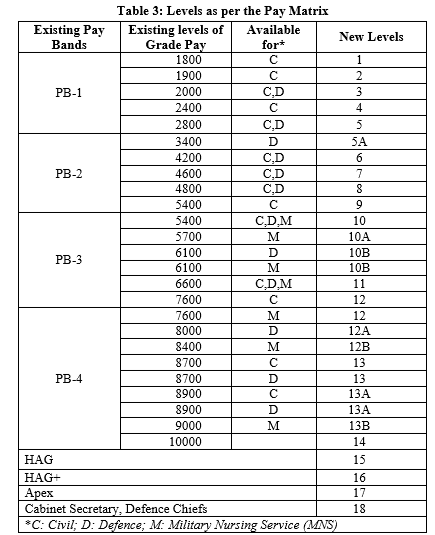
The Commission has designed the new pay matrix keeping in view the vast opportunities that have opened up outside government over the last three decades, generating greater competition for human resources and the need to attract and retain the best available talent in government services. The nomenclature being used in the new pay matrix assigns levels in place of erstwhile grade pay and Table 3 below brings out the new dispensation for various grades pay pertaining to Civil, Defence and MNS.

7th pay commission Pay Metrix 5.1.13 Although the VI CPC had mentioned that grade pay would be equivalent to 40 percent of the maximum of the pre-revised scale and that the grade pay will constitute the actual fitment, yet the computation varied greatly. After the implementation of recommendations, the difference became more pronounced in Pay Band 4 as compared to the other three pay bands. This resulted in varying fitment factors for various levels and promotional benefits that were perceived to be rather differentiated. The same pattern was discernible in the pension fixation too. 5.1.14 After analysing the issues brought out by various stakeholders, this Commission is suggesting a new pay model that is expected to not only address the existing problems but will also establish a rationalised system which is transparent and simple to use.

5.1.15 To begin with, the system of Pay Bands and Grade Pay has been dispensed with and the new functional levels being proposed have been arrived at by merging the grade pay with the pay in the pay band. All of the existing levels have been subsumed in the new structure; no new level has been introduced nor has any existing level been dispensed with.

5.1.16 The pay structures in vogue, by way of pay scales or pay bands, indicate the definite boundaries within which the pay of an individual could lie. It is however difficult to ascertain the exact pay of an individual at any given point of time. Further, the way the pay progression would fan out over a period of time was also not evident. Since various cadres are designed differently the relative pay progression also varies. The Commission believes that any new entrant to a service would wish to be able to make a reasonable and informed assessment of how his/her career path would traverse and how the emoluments will progress alongside. The new pay structure has been devised in the form of a pay matrix to provide complete transparency regarding pay progression.

5.1.17 The Commission has designed the new pay matrix keeping in view the vast opportunities that have opened up outside government over the last three decades, generating greater competition for human resources and the need to attract and retain the best available talent in government services. The nomenclature being used in the new pay matrix assigns levels in place of erstwhile grade pay and Table 3 below brings out the new dispensation for various grades pay pertaining to Civil, Defence and MNS.

5.1.18 Prior to VI CPC, there were Pay Scales. The VI CPC had recommended running Pay Bands with Grade Pay as status determiner. The Seventh CPC is recommending a Pay matrix with distinct Pay Levels. The Level would henceforth be the status determiner.


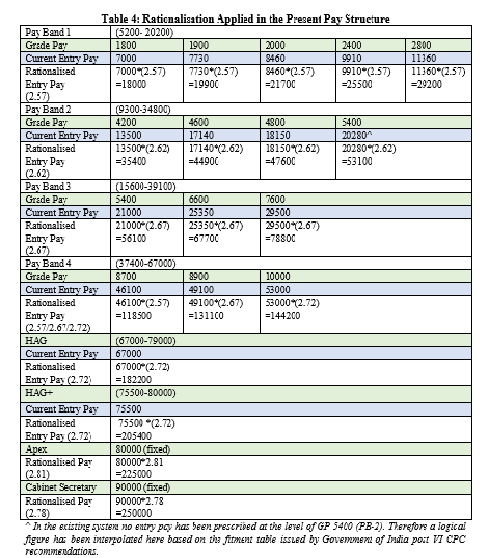
5.1.19 Since the existing pay bands cover specific groups of employees such as PB-1 for Group `C’ employees, PB-2 for Group `B’ employees and PB-3 onwards for Group `A’ employees, any promotion from one pay band to another is akin to movement from one group to the other. These are significant jumps in the career hierarchy in the Government of India. Rationalisation has been done to ensure that the quantum of jump, in financial terms, between these pay bands is reasonable. This has been achieved by applying ‘index of rationalisation’ from PB-2 onwards on the premise that with enhancement of levels from Pay Band 1 to 2, 2 to 3 and onwards, the role, responsibility and accountability increases at each step in the hierarchy. The proposed pay structure reflects the same principle. Hence, the existing entry pay at each level corresponding to successive grades pay in each pay band, from PB-2 onwards, has been enhanced by an ‘index of rationalisation’ as shown below in Table 4:

7th Pay Commission New Pay Metrix

5.1.20 While a carefully calibrated gradation has been adopted as the levels progress upwards, it would be seen that two levels, corresponding to GP 8700 and GP 10000 witness a slight departure.

i. In the existing system there is a disproportionate increase in entry pay at the level pertaining to GP 8700. To address this, the proposed increase at this level has been moderated.

ii. In so far as GP 10000 is concerned, this represents the Senior Administrative Grade, which carries a significantly higher degree of responsibility and accountability. Further, the levels of SAG and above are those which are involved in policy formulation.

iii. Hence, in recognition of the same, the entry pay pertaining to GP 10000 as well as that of HAG and HAG+ has been enhanced by a multiple of 2.72.

iv. The Apex pay of Secretary/equivalent and pay of Cabinet Secretary/equivalent has been fixed by applying indices of 2.81 and 2.78 respectively. The rationalised entry pay so arrived has been used in devising the new pay matrix. 5.1.21 The pay matrix comprises two dimensions. It has a “horizontal range” in which each level corresponds to a ‘functional role in the hierarchy’ and has been assigned the numbers 1, 2, and 3 and so on till 18. The “vertical range” for each level denotes ‘pay progression’ within that level. These indicate the steps of annual financial progression of three percent within each level. The starting point of the matrix is the minimum pay which has been arrived based on 15th ILC norms or the Aykroyd formula. This has already been explained in Chapter 4.2.

5.1.22 On recruitment, an employee joins at a particular level and progresses within the level as per the vertical range. The movement is usually on an annual basis, based on annual increments till the time of their next promotion.

5.1.23 When the employee receives a promotion or a non-functional financial upgrade, he/she progresses one level ahead on the horizontal range.

5.1.24 The pay matrix will help chart out the likely path of pay progression along the career ladder of any employee. For example, it can be clearly made out that an employee who does not have any promotional prospects in his cadre will be able to traverse through at least three levels solely by means of assured financial progression or MACP, assuming a career span of 30 years or more.